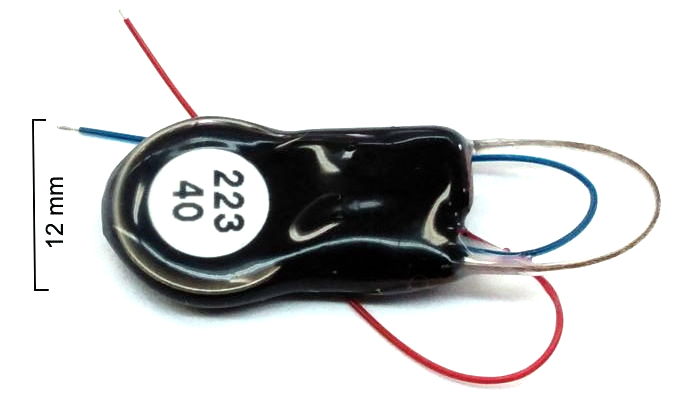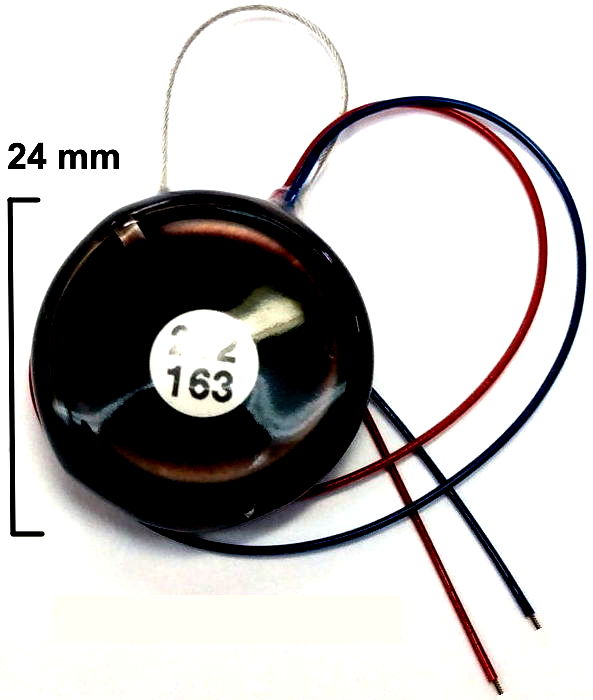
The Subcutaneous Transmitter (A3013) is a wireless sensor designed to monitor biometric signals within live animals. It is roughly 18 mm × 18 mm × 8 mm when encapsulated in epoxy. The sensor has three wires: two leads for analog pick-up and one antenna for radio-frequency transmission.

The encapsulation shown above is vacuum-resistant and water-proof. Three pins emerge from the encapsulation. We solder three wires to these pins. The antenna must be roughly 70 mm long and bend in a partial loop. The remaining two wires are analog pick-up wires, and can be any length.
We discuss the corrosion of wires here. We demonstrate how the diameter and finish of the wire has hardly any effect upon its performance as an antenna here. We show how water can leak into a wire and penetrate a transmitter, or corrode the internal conductor, here. We describe how various wires snapped while implanted in a live rat here. In this report, we describe our efforts to find a wire that will endure the repetetive stress imposed by movement in a live animal, and resist corrosion in the animal's body fluids.
All of the wires shown in the photograph above broke after a few days in a live animal. According to the sketches made by the student who implanted the transmitters, the leads were just long enough to reach from the transmitter in the rat's abdomen to the electrodes in the rat's skull. The antenna was fastened to the analog leads, as shown in the photograph. Even the antenna leads broke.
Two of the silver leads broke at the neck of the rat. We broken ends were twisted and kinked. The remaining leads, both copper and silver, broke where the wire entered the solder joint that fastened the wire to its pin on the transmitter. This point of entry is a point of stress concentration. Repetetive stress at the point of entry will open cracks in the surface of the metal. The opening of cracks by repetetive stress is called fatigue in material science.
The antenna wires broke too, also at the base. The antenna wires were bent into a loop. It would not be possible to introduce tension into the antenna by pulling on the leads. The antenna broke through repetetive stress induced by movement of the rat's body.
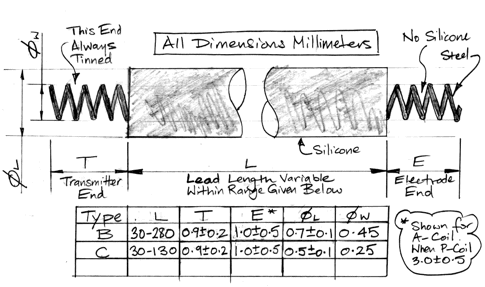
According to DSI, their implantable transmitters use "helical steel wire" insulated with silicone. Defibrilator leads are also made of helical steel wires. We are looking for a supplier of such wires, but have had no luck yet. In the meantime, we have the following candidates.
| Wire | Soldering | Stripping | Thumb Twists to Failure |
Gyrator Cycles to Failure |
|
|---|---|---|---|---|---|
| Bare 440-μm solid, tinned copper | Yes | None | 31, 28, 26, 30 | >3k ×2 | |
| PVC-insulated 250-μm solid copper | Yes | Tool | 30, 37, 41 | 400, <40k, <10k ×2, <25k |
|
| Teflon-insulated 200-μm solid silver 786500 | Yes | Blade | 30, 11, 25 | <15k ×2 200-600 ×2 <25k, 7k, 16k 1k, <21k |
|
| Bare 200-μm solid silver, stripped 786500 | Yes | None | 12, 8, 4, 13 | 1k, <21k | |
| Bare 250-μm spring steel | With Flux | None | 60 | ||
| Bare 125-μm 304V stainless steel, GWX-0050-30-05 | With Flux | None | kinked by 200 | >175k, >200k | |
| Bare 250-μm 304V stainless steel, GWX-0100-30-05 | With Flux | None | kinked by 200 | ||
| Teflon-insulated 75-μm half-hard 316 stainless steel, 791000 | With Flux | Blade | kinked by 200 | <40k ×2 57k, >57k, <25k 19k, >19k 3.5k, >13k |
|
| Bare 75-μm half-hard 316 stainless steel, stripped 791000 | With Flux | None | kinked by 200 | 41k, >55k | |
| Teflon-insulated 75-μm full-hard 316 stainless steel, 791100 | With Flux | Blade | kinked by 200 | 2.6k, <18k 34k1, <160k1 |
|
| Teflon-insulated 125-μm annealed 316 stainless steel, 791400 | With Flux | Blade | kinked by 200 | 40k, >107k, <27k | |
| Teflon-insulated 125-μm full-hard 316 stainless steel, 791600 | With Flux | Blade | kinked by 200 | >130k ×2, 200k, >225k |
|
| Teflon-insulated 75-μm tungsten, 796000 | No | Blade | 57, 120, 47 | ||
| Teflon-insulated 125-μm tungsten, 796500 | No | Blade | 14, 18, 56 | ||
| Bare 250-μm nitinol NW-010-36 | No | None | unaffected by 200 | ||
| Bare 125-μm nitinol NW-005-36 | No | None | unaffected by 200 |
| Metal | E (GPa) | σy (MPa) | εy (%) | Kc (MPa √m) |
|---|---|---|---|---|
| Pure Aluminum | 70 | 40 | 0.06 | 100 |
| Hard Aluminum Alloy | 75 | 500 | 0.67 | 23 |
| Copper | 120 | 60 | 0.05 | 350 |
| Gold | 80 | 40 | 0.05 | 300 |
| Iron | 200 | 50 | 0.02 | 100 |
| Nitinol | 50 | 450 | 0.90 | 35 |
| Silver | 75 | 55 | 0.07 | 300 |
| Stainless Steel | 200 | 300-500 | 0.15-0.25 | 150-50 |
| Tungsten | 400 | 1000 | 0.25 | 15 |
The table also gives some values of another important physical property: fracture toughness, Kc in units MPa √m. Fracture toughness is a measure of the stress at which a crack will propagate by fast fracture.
Consider the effect of bending a circular wire of diameter d in an arc of radius r. The strain on the outermost surface of the wire is d/2r. When this strain reaches the yield strain of the wire material, we will see plastic deformation and crack growth. The following table gives the minimum bending radius of various wires.
| Metal | Diameter (μm) | Radius (mm) | Cantilever Load (g) | 30-mm Bend Load (g) | Hanging Load (g) |
|---|---|---|---|---|---|
| Copper | 25 | 25 | 0.0001 | 0.0001 | 3 |
| Copper | 250 | 250 | 0.01 | 0.01 | 390 |
| Copper | 440 | 440 | 0.04 | 0.04 | 900 |
| Nitinol | 125 | 7 | 0.42 | 0.10 | 551 |
| Silver | 35 | 25 | 0.0003 | 0.0003 | 5 |
| Silver | 200 | 140 | 0.01 | 0.01 | 170 |
| Stainless Steel | 75 | 20 | 0.03 | 0.02 | 180 |
| Stainless Steel | 125 | 30 | 0.08 | 0.08 | 490 |
| Tungsten | 75 | 15 | 0.09 | 0.05 | 440 |
| Tungsten | 125 | 25 | 0.26 | 0.22 | 1200 |
So long as we do not bend a wire more sharply than its minimum bending radius, the wire will return to its original straight shape as soon as we release it. The values given in the table seem to be roughly twice as large as we observe with actual wires. We see no deformation of 125-μm stainless steel wire until we reach a radius of 15 mm. We see no deformation of 75-μm tungsten wire until we reach a radius of 10 mm.
The cantilever load column in the table gives the load the wire can hold up when arranged as in the drawing below. The wire is clamped horizontally at one and and bends down to a weight. We assume the radius of the bend is constant, which is not quite true in the actual case, but almost true. The torque in the wire where it emerges from the clamp has to equal the torque generated by the weight turning about the clamp point.
T = Fr = mgr
where m is the mass of the weight, g is gravity (≈10 m/s/s), r is the radius of curvature, and T is the torque in the wire at the clamp. The torque is a result of tension on the outer half of the wire and compression on the inner half. It is a function of the shape of the wire, its diameter, the Young's Modulus of the material, and the radius of curvature. For the sake of brevity, let us simplify the calculation of T by assuming a square cross-section of width 2d/3, where d is the wire diameter. We should get roughly the right answer and our math will be much simpler. (In fact, we get exactly the right answer.)

The strain in element dy is y/r. The stress is Ey/r. The total tension is Eywdy/r (note that dy is the element height). The torque this element generates about the center of the wire is Ey2wdy/r. If we integrate this torque from y = −w/2 to y = +w/2, we obtain a total torque of Ew4/12r. But w = 2d/3, so our estimate of the total torque for a circular wire is Ed4/60r.
We recall that T = mgr, and also that the minimum bending radius, which corresponds to maximum torque, is r = d/2εy = Ed/2σy. The largest mass the wire can support in the manner shown above is:
mmax = σy2d2/15gE = εy2d2E/15g
This is the maximum cantilever load we give in the final column of the table above. The cantilever load is an indication of how much the wire resists being bent into its minimum radius. It is therefore an indication of the force required to kink the wire. We see that very little force is required to kink any of the wires, but that nitinol offers the best resistance to kinking with its 7-mm bending radius and 0.42-g cantilever load.
The 30-mm bend load column give us the cantilever load required to bend the wire in a 30-mm radius. This load is a measure of the flexibility of the wire. If the minimum elastic bending radius of the wire is greater than 30 mm, we assume 30-mm bend load is equal to the maximum cantilever load, although this is not exactly true: the 30-mm bend load may be two or three times higher, but not ten times higher. When the minimum elastic bending radius is less than 30 mm, the 30-mm bend load is propotionally less.
We see now why copper and silver are recommended as flexible wires. They are indeed flexible. The 200-μm silver wire presents half the resistance to bending as the 75-μm stainless steel wire. But this flexibility comes at a price: the wire deforms when it bends, and repetetive deformation will damage the wire.
The hanging load column gives the maximum load you can hang on the wire without it yielding, assuming you clamp the wire vertically. We calculate this mass by multiplying the yield stress by the cross-sectional area of the wire. We see that a copper or silver wire narrow enough to provide an elastic bending radius less than 30 mm will be barely strong enough to support the weight of the transmitter, and certainly not strong enough to endure any repetetive stress in the body of the rat or in the Wire Gyrator.
Copper and Silver wires of sufficient strength have too large a bending radius. Nitinol is almost impossible to solder. That leaves tungsten and stainless steel as the best choices of material. Both are resistant to corrosion. Tungsten's fracture toughness is one tenth that of annealed stainless steel, meaning it is brittle. It will tolerate kinks and sharp bends ten times less well than annealed stainless steel, and three times less well than hardened stainless steel.
[19-MAR-08] We leave the gyrator running with a pair of silver wires and a pair of copper wires at 4:15 pm.
[20-MAR-08] At 9:15 am, both pairs of wires are broken. We performed a similar test earlier, lasting an hour, during which neither wire pair failed. The copper wires were on the upper wheel, which gyrates at 0.16 cycles/s. The silver wires were on the lower wheel, gyrating at 0.25 cycles/s. We conclude that failure for silver wires occurs at between 900 and 15,000 cycles, and for copper wires occurs between 700 and 10,000 cycles. We leave the gyrator running at 9:30 am with a solitary, un-weighted silver wire on the lower wheel, and a solitary, teflon-insulated un-weighted copper wire on the upper wheel.
[20-MAR-08] 6:00 pm. The silver wire broken and the copper wire still intact. We removed the silver wire and put in its place a pair of bare 125-μm, 304V stainless steel wires with a weight.
[21-MAR-08] At 8:15 am the 125-μm steel wires are still intact with their weight. The free-hanging copper wire is still intact. We're not so interested in copper wire any more, so we remove the copper wire and replace it. In its place on the upper wheel we put two lengths of 75-μm, 316 stainless steel, teflon-insulated wire, part number 791000 from A-M Systems, Inc. This wire is half-strength for greater flexibility. Its outer diameter is 140 μm. We scraped off the insulation and soldered easily with acid flux. We weighed down the wires and started them gyrating. Starting at 8:30 am, we have two sets of weighted stainless steel wires in the gyrator. On is bare 304V stainless, the other is insulated 316 stainless. We are interested to see if the insulated wire wears out more quickly. The insulation will contribute to the stress concentration at the end of the wire, and therefore accelerate fatigue.
[21-MAR-08] 3:30 pm. Both sets of wires are still intact. Through the ×5 loop we see no sign of fatigue near any of the joints.
[24-MAR-08] At 9:00 am we enter the OSI office and find the 75-μm 316 stainless teflon-insulated wires are both broken just at the edge of the solder joints on the moving pins of the upper wheel. The 125-μm bare 304V stainless wires show no signs of fatigue. We put a new pair of 75 μm 316 wires on the upper wheel, hoping to obtain a more precise measurement of their fatigue resistancde this week, when we plan to check twice a day. The wire gyrator itself is showing no signs of wear. Its current consumption is 80 mA. There is a slight squeek in one of the wheels.
[25-MAR-08] 9 am. Both sets of wires still intact. We examine the condition of the wires near the joints. The 75 μm wires bend downwards immediately outside the solder joints. These wires are made of half-strength 316 stainless steel. The 125-μm wires proceed horizontally from their joints and bend gracefully downwards towards the weight. The 75-μm wires have yielded at the joints, and are undergoing low-cycle fatigue through repetetive plastic deformation. The 125-um wires have not yielded. They are undergoing high-cycle fatigue through repetetive elastic deformation. We install a computer and data acquisition system to monitor the wires. We join each pair of wires at the wheel end, and connect the other ends to a Resistive Sensor Head (A2053A). We set our Acquisifier to measure the resistance of the loop every hour. If a wire breaks, we will see the loop resistance rise to infinity. The Acquisifier stores its measurements to a log file, which we can come and look at every few days. We see some black powder beneath one of the rubber collars on the lower shaft of the gyrator. Current consumption varies from 70 mA to 90 mA depending upon the position of the two wheels.
[26-MAR-08] 8:00 pm. Both sets of wires still intact. Gyrator is squeeking a little louder, but otherwise running well.
[28-MAR-08] 2:00 pm. One of the 75-μm wires on the upper wheel has broken next to the gyrating solder joint. The computer log file tells us the wire broke at 1:00 pm today, an hour before our arrival. The 125-μm wires show no sign of wear. We put a fresh pair of 200-μm silver wires on the top wheel, hoping to get a better measurement of their life with the help of the computer. We performed some maintenance on the gyrator: tightened some collars, shaved off some protruding collar corners, and checked gears.
[28-MAR-08] 6:30 pm. Both silver wires broken at the gyrating solder joints. The computer says they failed in less than an hour. We set up the wires as follows. Left pin, lower wheel is the same 125-μm stainless steel, with 175k gyrations. We remove the other such wire on the right pin. The wire is still straight when we set it back on the table. We replace with a 200-μm silver wire. We put a 75-μm steel wire on the left top pin, and a 250-μm copper wire on the right top. We use individual putty weights on the wires so they can fail one at a time and not increase the load on their partners. We leave the computer recording the state of the wires every 10 minutes, to give more resolution in our measurement of the silver wire failure. We begin the test at 7:00 pm.
[30-MAR-08] 2:30 pm. The copper and 75-μm steel wire on top wheel both broken. Silver wire on bottom wheel broken. The 125-μm steel wire is still intact. But data acquisition system has failed. There is something wrong with our Resistive Sensor Head (A2053). We record the fact that the wires broke in less than 25k gyrations (top wheel) and less than 40k gyrations (lower wheel). We repaired the broken A2053. We removed all the wires, including the 125-μm steel wire, which has endured 200k gyrations. We put two 75-μm steel wires on the lower wheel and two 200-μm silver wires on the upper wheel. We stripped the silver wires with a blade, being sick of messing around trying to burn off the insulation.
[31-MAR-08] 9:00 am. One silver wire has broken, but only after 10k gyrations. The other wire is intact. We place a steel wire next to it, so we can keep gyrating the silver wire. The gyrator current now varies from 100 mA to 120 ma, which is up 30 mA from early in its life.
[02-APR-08] 9:30 am. The 75-μm steel wires broke after 19k gyrations. The remaining silver wire broke after a total of 16k gyrations. The gyrator current varies from 90 mA to 110 mA. Squeeking is sustained. We put a pair of 75-μm steel wires on the upper wheel, and a pair of 200-μm silver wires on the lower wheel. We strip the insulation off the wires with firm strokes of a razor blade. Most of the time, the insulation comes off with the first stroke.
[02-APR-08] 7:00 pm. We received several packs of steel guitar strings. Those with diameter 0.024" and up consist of a straight steel wire core and a wound coil of 0.005" or 0.010" steel around the core. We hoped to remove the coil from the core, and so use the coil as a helical steel lead. But the only way we found of removing teh coil was by unwinding it from the core.
[03-APR-08] 9:00 am. Both silver wires are broken. The first broke after 1k gyrations. The second broke some time before 21k gyrations when we returned to the office. One steel wire broke after 3.5k gyrations. The other is still intact after 13k gyrations. Gyrator current is 80 mA to 110 mA. We remove the teflon insulation from two lengths of 200-μm silver wire and two lengths of 75-μm steel wire. We do this by scraping 5 mm of insulation off the end of each wire, holding the exposed wire with tweezers, pinching the insulation between our nails and pulling it off the other end of the wire. We cut 10 mm off the end we scraped and held. What remains is wire that has not been touched by blade or tweezers, and is free of insulation. We put the silver wires on the lower wheel and the steel wires on the upper wheel.
[04-APR-08] 9:00 am. Both bare silver wires are broken, first after 1k gyrations, second before 21k. We have obtained the same result with bare silver wire and insulated wire. It does not matter whether the ends were scraped with a scalpel or not: 200-μm silver wires survive for roughly a thousand gyrations. Meanwhile, both bare steel wires are intact after 13k gyrations. We pull gently upon them, and they appear strong. We place two bare 440-μm copper wires on the lower wheel. We have to bend the wires as shown in the photograph below, so that they don't stop the gyrating axle (Item 4 in the Gyrator picture) from turning.

[04-APR-08] 12:30 pm. No wires have broken. The steel wires have now endured 15k gyrations. The copper wires have endured 3k. But the copper wires are twisted around one another ten times, which means the gyrating axle on the lower wheel is sticking occasionaly (sticks on 1 gyration out of 300). We remove the copper wires. We have three new rolls of wire from A-M Systems. We place two teflon-insulated, 125-μm, full-hardened 316 stainless steel wires on the bottom wheel. We leave the existing bare 75-μm, half-hardened 316 stainless steel wires on the top wheel. Gyrator current varies between 90 mA and 120 mA.
[07-APR-08] 9:00 am. One 75-μm bare steel wire on the top wheel broke after a total of 41k gyrations. The second wire has endured 55k gyrations and is still intact. The 125-μm insulated wires on the bottom wheel are intact and appear unaffected by the 40k gyrations they have endured so far. The Gyrator itself is running well. Current consumption is 90 mA to 120 mA. We remove the top 75-μm wire and replace it with a pair of insulated, full-hardened 75-μ wires.
[08-APR-08] 4:00 pm. Both 75-μm full-hard steel wires on the upper wheel are broken. One broke after only 2.6k gyrations. The 125-μm full-hard steel wires on the lower wheel, meanwhile, are still intact after a total of 57k gyrations. We put 125-μm annealed steel wires on the upper wheel. The upper gyrating axle sticks and the wires get twisted up. We loosen the collars on both gyrating axles. Now they rotate more easily. We put another pair of the same wires on the top wheel. We see accumulation of black powder beneath a metal collar on the lower wheel shaft. Current consumption is 100 mA to 120 mA.
[11-APR-08] 9:00 am. All wires still intact. Wires on lower wheel have endured 115k gyrations, those on upper wheel 38k. Gyrator running smoothly. We order 75-μm and 125-μm tungsten wires.
[11-APR-08] We order teflon-insulated tungsten wire of two thicknesses: 75 μm and 125 μm. We plan try the tungsten wires in the Wire Gyarator. We predict that a 75-μm tungsten wire will be as resistant to the Wire Gyrator as a 125-μm stainless steel wire. We predict that tungsten wire will not do as well as steel in the thumb test, where repeated plastic deformation will open cracks and lead to fracture.
[14-APR-08] 9:00 am. One of the annealed wires broke after 40k gyrations, which as only a few hours after we last checked upon the wires. The other annealed wire is still intact after 80k. The full-hardened steel wires are both intact after a total of 180k. Gyrator is running well. Current consumption varies from 100 mA to 130 mA, which is 30 mA higher than when the Gyrator was new. We replace the broken wire on the upper left pin with another of the same sort.
[16-APR-08] 10:00 am. One of the hardened steel wires is broken. The newer annealed wire is broken. We neglected to press Run_Repeat when we last left the office. The lower wheel performed 40k gyrations and the upper wheel 27k. We put two hardened, insulated, 125-μm wires on the upper wheel and two insulated, copper 250-μm wires on the lower wheel.
[18-APR-08] 9:00 am. One copper wire broke after 400 gyrations. The other broke some time before 40k. The two 125-μm steel wires are still intact after 27k gyrations. We put two 75-μm steel wires (full-hardened, teflon-insulated) on the lower wheel. We make the wires 125 mm long instead of 100 mm long. The weights hang down lower and there is less tension in the wires. Gyrator current is between 80 mA and 110 mA. The sun is shining on the motor.
[22-APR-08] Our tungsten wire arrives. Both thicknesses break in the thumb test. One 75-μm wire endures 120 twists. One 125-μm wire breaks after 14 twists. We can bend the 75-μm wire into a 10-mm radius before it starts to deform. Our 125-μm stainless steel will endure a 15-mm radius before it shows signs of deformation. We cannot solder to tungsten wire, even with the help of acid flusx. We cannot subject our tungsten wire to our standard Wire Gyrator test because we cannot solder the wire to the gyrator's pins.
[23-APR-08] 7:40 pm. After 130k gyrations, 125-μm steel wires on top wheel are still intact. The 75-μm wires on the lower wheel are both broken. The first broke at 34k. Failure at 34k is consistent with other results with 100-mm wires of the same diameter. We leave the gyrator running with only one pair of wires. Current is between 100 mA and 120 mA.
[30-APR-08] 6:00 pm. After 225k gyrations, 125-μm steel wires on top wheel are still intact. The gyrator was making a lot of noise when we came in. We reduced the size of the aperture through which the main drive shaft passes next to the first large gear. After that, the machine ran more smoothly than ever. Current consumption is now 60 mA to 80 mA, lower than when we began.
[11-MAY-08] 2:00 pm. The Gyrator has stopped. The gears still turn freely when moved by hand, but the motor does not generate any torque. We conclude that one of the motor brushes has worn out. The steel wires are intact and show no signs of fatigue.
The best way to remove insulation from a thin wire is with a sharp blade. Put the blade on a flat surface. Press the blade against the wire where you want to cut the insulation. Pull the wire away from the blade, leaving the insulation behind on the far side of the blade. When you see the short length of empty insulation, you know you have done the job correctly. Do not scrape the blade along the wire. The insulation cannot come off when you scrape the wire because you are pressing it against the table.
We use acid flux to wet the surface of steel with solder. We clean off the flux with alcohol and then water. Once the wire tip has been tinned, we can be soldered at any time.
The following instructional video shows us stripping the end off a 125-μm stainless steel wire and tinning the end.
To prepare the antenna, we tin one end and solder it to its pin. We cut the wire to 70 mm and pull it past the tip of our thumb nail so that it deforms into a loop, as shown below. This procedure serves also to stretch the teflon insulation around the wire so that a few millimeters of empty insulation protrude past the tip of the stainless steel. In a live animal, this empty insulation will fill with body fluids. But the resistance presented by such a narrow tube of body fluid will be greater than 1 kΩ, and therefore have no effect upon the performance of the antenna. We find the steel antenna loop provides robust transmission from inside a closed fist for ranges up to 50 cm.
When we started working with steel wires, we used Kester SP-30 acid flux. Kester no longer makes SP-30, but the tub we had was only a year old. The SP-30 is zinc chloride in petrolatum (also known as petroleum jelly). The petrolatum must be cleaned off with alcohol and a brush or there is a risk of the flux attacking imperfections in the stainless steel surface.
We later moved to Superior Flux's No. 75 Heavy Duty Flux. The No. 75 flux is water-soluble. We found it much easier to solder stainless steel wires with the No. 75 flux. We dip the bare steel in the flux and tin the wire with a soldering iron. The tinning works immediately every time. Afterwards, the flux washes off in hot water (60°C). We found that the joints we made with No. 75 flux were stronger then those made with the SP-50, as we describe below.
We must attach three wires to an A3013A. Two are analog wires and one is the antenna. When we solder the antenna lead, we must make sure the transmitter is turned off, or else we risk destroying its radio-frequency power source. The wire we use for the antenna can be thin.
Our Process X encapsulation provides three pins to which these wires must be soldered. But we find that the wires pull out of the solder joints after a week in a live animal. An alternative to Process X is Process A, in which we solder the wires directly to the circuit board. We solder the antenna and X− to plated holes in the board, and X+ to a surface-mount pad shared by a ceramic capacitor.
[13-NOV-08] The figure below shows two 316-Stainless 125-μm full-hardened steel wires soldered to two pins. We used SP-30 petrolatum-based acid flux to solder one of them (1) and No. 75 water-based acid flux to solder the other (2).

These joints are similar to those we use with our Process X encapsulation process, where pins bring the transmitter connections out through the epoxy body. With the help of a weighing balance and some weights, we measured the weight each wire could lift when the pin was held horizontally, upsid-down, so that the weight pulled the wire at right angles to the wire. With this arrangement, the pin is above the wire and only the thin layer of solder beneath the wire holds it in place. With sufficient weight, the wire pulls out through the solder. We performed the experiment with six joints soldered with aqueous acid flux and six times with petrolatum acid flux. We present our results in the table below.
| Flux | Joint | Weight (g) |
|---|---|---|
| Petrolatum Acid | Pin and 125-μm Steel Wire | 60, 40, 40, 50, 50, 60 |
| Aqueous Acid | Pin and 125-μm Steel Wire | 90, 80, 80, 140, 180, 90 |
| No-Clean | Pin and 250-μm Cu Wire | >1000 |
| Aqueous Acid | Pad and Coiled 125-μm Steel Wire | >1000 |
| Aqueous Acid | Pin and Coiled 75-μm Steel Wire | 350 |
| Aqueous Acid | Pin and Coiled 125-μm Steel Wire | 1200 |
The averge strength of the petrolatum joints is 50 g, compared to 110 g for the aqueous joints. We tried a thicker, copper wire in the same arrangement. With a 1000 g weight the pins pulled off the circuit board.
We twisted the end of a 125-μm steel wire and soldered it to a surface-mount pad on a circuit board, as shown below. This joint held 1000 g before the knot on the other end of the wire broke.

[14-NOV-08] We stripped the silicone off a transmitter encapsulated with Process X. The pins are now exposed. We attached wires with coiled tips to the pins. We soldered the other end of each wire to a circuit board, put the circuit board in a zip-lock bag and put weights in the bag to measure the strength of the joint. We held the pin horizontal to duplicate our earlier experiments with straight wires.
The 75-μm wire held 350 g, or 3.5 N. The yield stress of our full-hardened stainless steel should be around 500 MPa, which suggests a 2.2 N breaking force for a 75-μm wire. It appears that the wire is breaking before the joint yields. The 125-μm wire held 1200 g, or 12 N. We expect the wire to break at 6 N.
Joints between a coiled wire and a surface mount pad are strong also, as are joints between a bent wire tip and a plated hole. Joints between a straight wire and a pin are weak in the direction perpendicular to the pin. When soldered with aqueous flux they can withstand only 1 N before the wire tears out of the solder. When soldered with petrolatum flux, they are weaker still: 0.5 N. But if we coil the tip of the wire before we solder it to the pin, we obtain a much stronger joint. From now on we will use coiled wire ends with connector pins.
We conducted a series of experiments over the course of seven weeks in an effort to identify a fatigue-resistant wire. In the end, we choose choose teflon-insulated, full-hardened, 125-μm diameter, 316 stainless steel. We strip the insulation from these wires with a scalpel. We tin the ends with the help of water-soluble acid flux. We attach the wires to pins by coiling their tips and soldering the coil to one side of the wire. We use the same coiled tip when we solder a wire to a surface mount pad. When we solder the wire into a plated hole, we bend the tip and cut it short. All these joints are stronger than the wires themselves. We wash the flux off with hot water. We apply two coats of silicone dispersion to the entire transmitter. The result is a water-proof transmitter with strong, water-resistant wire attachments. We curl the antenna wire by running it through our fingers. The result is a loop that provides good omni-directional performance and is insulated at the end by a short length of stretched teflon insulation with no wire in the center.
The steel wires endure over a hundred thousand gyrations when loaded by a weight equal to that of the entire transmitter. With a loop of free wire in the animal, and the transmitter supported within the animal by the animal's skin, we expect the wires to endure millions of repetetive stress cycles, which will be sufficient for a year's operation inside a live animal, provided the transmitter is implanted in such a way that the wires are not under stress.