 Telemetry Antenna (A3015) Manual
[11-JUN-26] The Telemetry Antenna (A3015) is designed to receive signals from our small-animal telemetry sensors. These sensors use the 902-928 MHz Industrial, Scientific, and Medical (ISM) band, so the A3015 antennas are designed to be most sensitive to radio waves in this range.
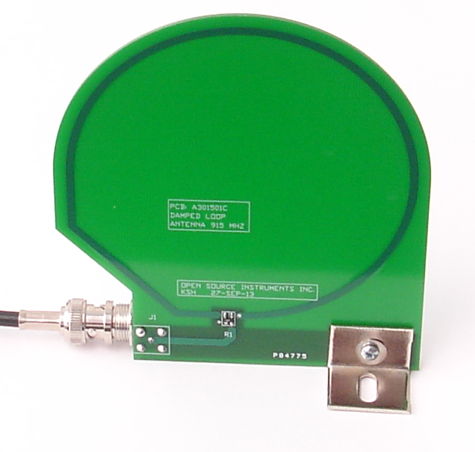
We use these same antennas to transmit commands to our Implantable Stimulators. The A3042B-16 Telemetry Control Box (TCB), for example, provides sixteen antenna inputs. Each antenna input has its own independent telemetry receiver, but also a command transmitter. The antennas spend almost all their time receiving telemetry signals, but occasionally the A3042B TCBs will commandeer the antennas for command transmission.

Most radio-frequency antennas are designed to maximize sensitivity in their most sensitive direction. When we set up two stationary antennas for communication, we can align them so that their most sensitive directions coincide. The A3015, on the other hand, must communicate reliably with antennas implanted in freely-moving antennas. The animal will turn, stand up, roll over, and move around its cage. The ideal antenna for telemetry reception would be an omnidirectional antenna: one that is equally sensitive in all directions. But a truely omnidirectional antenna is impossible to construct, so we have done our best to approach the omnidirectional ideal in the design of the A3015.

For a presentation of our original antenna study, see Omnidirectional Antennas. In the end, we found that a damped, full-wave loop antenna provides the best omnidirectional behavior. By "damped" we mean their natural resonance at their most sensitive frequency is damped by the presence of an attenuator to the base of the loop. This attenuator also serves to stop radio-frequency oscillations that might otherwise arise in the coaxial antenna cable. The attenuator also greatly improves the performance of the antenna in highly reflective environments such as Faraday enclosures, as we demonstrate in Impedance Matching below.
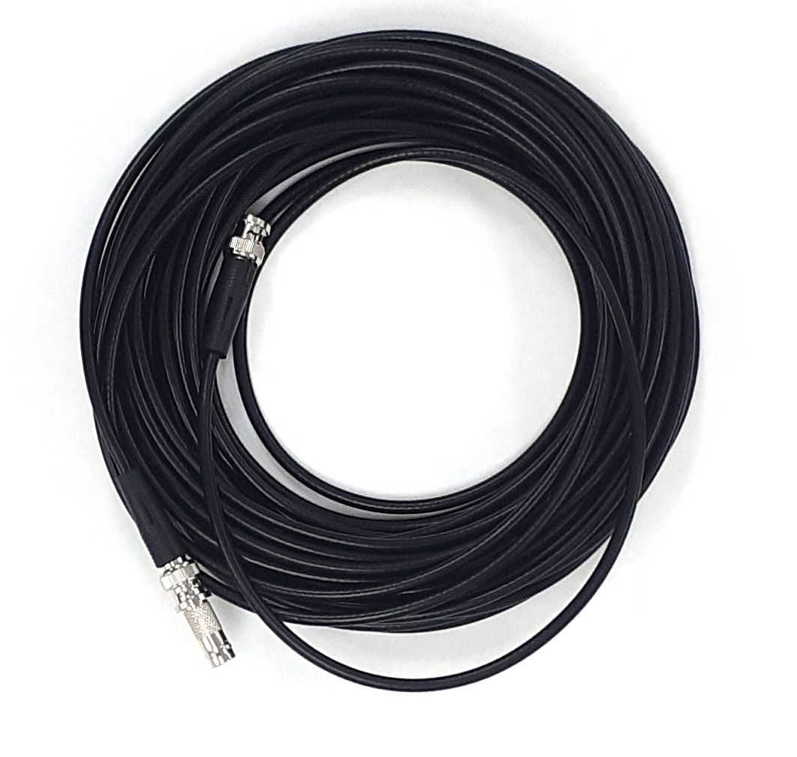
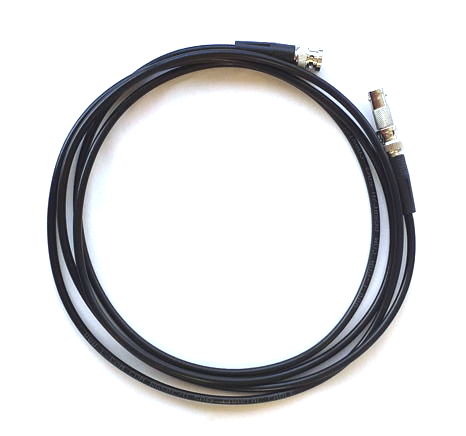
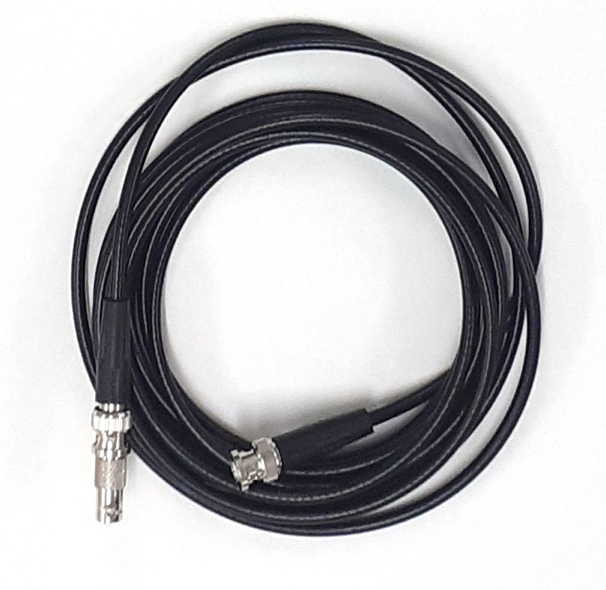
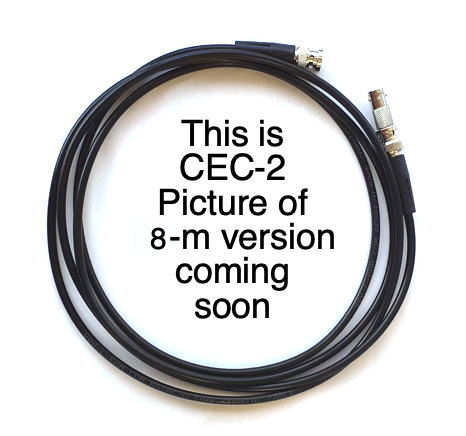
The A3015 antennas use RG-58C/U coaxial cable with BNC connectors. The standard A3015 antennas come with a 2.3-m coaxial cable. We can extend these 2.3-m cables, or replace them with shorter cables, by ordering Coaxial Extension Cables (CEC), which we provide in various lengths. Each extension cable includes a BNC union with which we can connect the cable to another coaxial cable. Signal power along the coaxial cable drops by 0.7 dB/m, but so does the power of interference in the same 900-930 MHz range that we pick up with the same antenna. Our telemetry receivers are sensitive, so that reception is always limited by the ratio of signal power to interference power. Thus we can extend the antenna cables to a length of 15 m with no loss of performance whatsoever, and most likely 50 m would be no problem either.
[11-JUN-26] The following versions of the A3015 are defined. Three are active. We include in the table our coaxial extension cables.
| Version | Name | Description |
|---|---|---|
| A3015A | Undamped Loop Antenna | 320-mm wire loop with stand, discontinued |
| A3015B | Damped Loop Antenna | 320-mm wire loop with stand, discontinued |
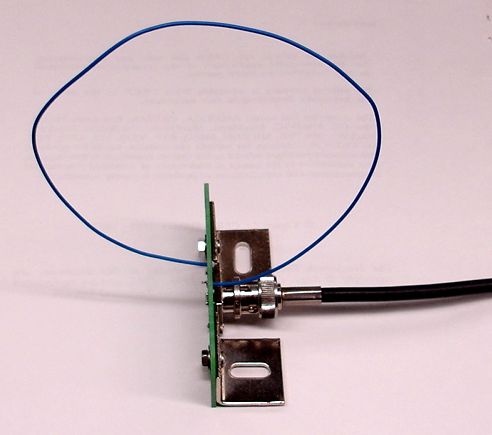
| A3015C | Damped Loop Antenna | 320-mm copper trace with stand and 2.3-m cable, active |
| A3015D | Undamped Aquatic Antenna | 50-mm wire loop with 2.3-m cable, active |
| A3015E | Damped Loop Antenna | 320-mm copper trace with zip-ties and 2.3-m cable, active |
| CEC-1 | Coaxial Extension Cable | 0.91 m (3 ft) with BNC union, active |
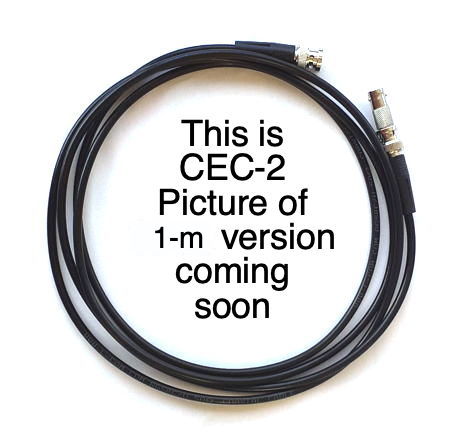
| CEC-2 | Coaxial Extension Cable | 2.3 m (7.5 ft) with BNC union, active |
| CEC-5 | Coaxial Extension Cable | 4.6 m (15 ft) with BNC union, active |
| CEC-8 | Coaxial Extension Cable | 7.6 m (25 ft) with BNC union, active |
| CEC-15 | Coaxial Extension Cable | 15 m (50 ft) with BNC union, active |
The A3015A and A3015B are obsolete. These were undamped antennas, which perform poorly in Faraday enclosures, as we describe below. The undamped aquatic loop antenna is for immersion in water, allowing aquatic telemetry. No Faraday enclosure is required for aquatic systems because the water itself acts as an absorber of interference and an attenuator of reflections. The coaxial extension cables can be up to fifteen meters long. For coaxial cables 2.6 m and shorter, we provide RG-58C/U cable, which is flexible, robust, and introduces tolerable loss. For lengths 4.6 m and up, we have in the past used RG-58C/U, but now we have decided to switch to RG-58/U cable because it introduces half the loss per meter, is equally robust, and also holds its shape, which is better for routing around and over obstacles.
[11-JUN-26] The following table summarizes the properties of common coaxial cables. We use either RG-58C/U or RG-58/U cables terminated with BNC connectors to carry our 902-928-MHz telemetry signals to and from our telemetry antennas. The RG-58C/U is more flexible, which is nice when arranging cables immediately behind a shelf or bench-top. The power loss at 900 MHz in RG-58C/U is 0.67 dB/m, which is negligible for cables less than a few meters. The RG-58/U is stiffer, on account of its solid central conductor, and tends to hold its shape, which is often a desirable feature when setting up long cables running across a laboratory. Its loss is only 0.34 dB/m, which means that a twenty-meter RG-58/U cable will attenuate 900-MHz power by a factor of 5, while an RG-58C/U of the same length will attenuate 900-MHz power by a factor of 25. Given that interference will be attenuated right along with our telemetry signals, this attenuation does not degrade the signal to noise ratio for telemetry reception. Nevertheless, we have recently started using RG-58/U for our coaxial extension cables of length 4.6 m (15 ft) and longer, on the grounds that a stronger signal is always better.
| Type | Impedance (Ω) |
Diameter (mm) |
Attenuation @ 100 MHz (dB/m) |
Attenuation @ 900 MHz (dB/m) |
Attenuation @ 2400 MHz (dB/m) |
Comment |
|---|---|---|---|---|---|---|
| RG-58/U | 50 | 5.0 | 0.11 | 0.34 | 0.61 | Solid Conductor |
| RG-58C/U | 50 | 5.0 | 0.16 | 0.67 | 1.2 | Stranded Sn-Coated Conductor |
| RG-58A/U | 50 | 5.0 | 0.18 | 0.70 | 1.3 | Stranded Sn-Coated Conductor |
| RG-59/U | 75 | 5.9 | 0.08 | 0.25 | 0.40 | Solid Conductor |
| RG-59B/U | 75 | 5.9 | 0.11 | 0.37 | 0.65 | Cu-Coated Steel Conductor |
| RG-213/U | 50 | 10 | 0.06 | 0.25 | 0.46 | Stranded Conductor |
| RG-214/U | 50 | 10 | 0.06 | 0.25 | 0.46 | Double-Shielded Stranded Ag-Coated Conductor |
| RG-142B/U | 50 | 5.0 | 0.10 | 0.4 | 0.7 | Double-ShieldedTeflon Dielectric Solid Ag-Coated Conductor |
| RG-223/U | 50 | 5.4 | 0.13 | 0.45 | 0.8 | Double-Shielded Solid Ag-Coated Conductor |
| RG-174/U | 50 | 2.8 | 0.30 | 0.94 | 2.5 | Stranded Conductor |
When we purchase coaxial cables, we test them before we ship them. When trying out cables marked "RG-58C/U" and "RG-58/U" in the past, we have several times discovered that they do not meet the specification of either cable type. We have observed attenuation in RG-58C/U cables up to three times the value in dB/m that the specification demands. Even if we purchase from the same manufacturer the same exact part, we test a sample of the cables to make sure that the connectors and cables have not, by some error, been made with the wrong components.
[10-MAR-25] The coaxial cable we use to connect the antenna to our receiver or transmitter circuit presents its own impedance to the antenna. The most common values for coaxial cable impedance are 50 Ω and 75 Ω. If we know the polarization of our incoming signal, and the signal is weak, we benefit from matching our antenna and cable impedance closely. The close match allows us to extract more power from the antenna, or deliver more power to it. But if we do not know the polarization of the incoming signal, a poor impedance match makes the antenna less discriminating. It's maximum sensitivity drops, but its minimum sensitivity rises. In the case of loop antennas, such as the A3015A or A3015B, the mis-match between the cable and antenna dampens the asymmetric resonance of the loop in the vertical direction, which would otherwise render the loop insensitive to horizontally-polarized waves. We present measurements of the maximum and minimum sensitivity of various antennas here.
[10-MAR-25] An antenna combiner takes the signals from several antennas and adds them together to produce one combined antenna signal. Antenna combiners are useful if we have more antennas in our telemetry system than we have antenna inputs on our telemetry receiver. Our original Data Receiver (A3018D) provided only one antenna input, so an antenna combiner was essential for reception from more than one bench-top Faraday enclosure. Our Octal Data Receiver (A3027 provided eight antenn inputs, but some IVC rack systems need sixteen antennas to cover all cages, so dual antenna combiners are deployed to bring all sixteen antenna signals into the receiver. Our latest telemetry receiver, the A3042B-16 TCB, provides sixteen independent antenna inputs, and so far, this has proved sufficient for all enclosures. We do not expect antenna combiners to play a part in future telemetry systems, but they remain an essential component in older systems.
The simplest combiner we can use is a BNC T-junction, like this. It joins two antenna cables together. The T-junction is inexpensive and readily available. But the T-junction has two disadvantages. When we connect two cables together directly, we lose at least half of our signal power. And we can destabilize the antenna amplifier as well, because the signals propagating along the cables reflect from the T-junction. Our Data Receiver (A3018D) has one antenna input, a deficiency of gain, and a tendency to oscillate. The T-junction combiner does not work well with its antenna amplifier.
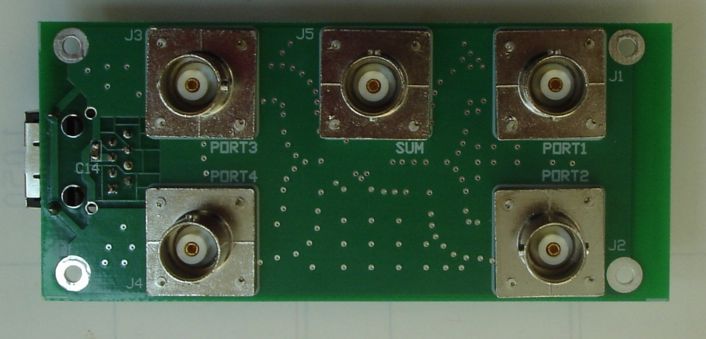
Better than a T-junction is a passive combiner that adds two or more antenna signals together without loss and without reflections. The Antenna Combiner (AC4A) is a four-way combiner made out of a ZB4PD1-2000. The AC4A consists of a four-to-one passive power combiner, two BTRM-50, which are 50-Ω terminators, and a short coaxial cable.

In the early days of our telemetry system's development, we equipped each bench-top faraday enclosure with one centrally-located antenna. We then connected four such antennas to a single receiver input with the AC4A antenna combiner. Or we used a ZAPD-1 to connect two antennas to one receiver input. These passive combiners attenuated our antenna signal less than 1 dB. Nowadays, we place four antennas in each bench-top enclosure and connect each of them to a separate, independent antenna on a sixteen-way receiver.
If we are going to have a circuit combining antenna signals, we can add amplification to the combiner as well, which is shat we did in our discontinued Active Antenna Combiner (A3021B). This device amplifies each of four inputs before adding them with a 4-way passive combiner.
The Octal Data Receiver (A3027) has eight antenna inputs, each of which provides ample gain and is unconditionally stable. We can combine antenna signals with T-junctions and see no significant degradation of reception. We present a comparison of passive, active, and T-junction combiners in the antenna chapter of the A3027 manual. The implication of these tests is that a T-junction joining two antenna cables is just as good as any other combiner, but three T-junctions joining four antenna cables is significantly less effective than an AC4A or A3021B combiner. Thus we should feel free to connect up to 16 antennas to an Octal Data Receiver (A3027) using eight BNC T-junctions.
[10-MAR-25] Using the power-measurement apparatus described above, we mixed 864-MHz LO with 910-MHz RF to obtain a −14 dBm IF signal. We passed the RF signal through a 240-cm cable on the way to the mixer. We unplugged the cable from the RF source and inserted an 80-mm whip antenna into its BNC socket output. We plugged an A3015A Loop Antenna into the free end of the cable that had previously been connected to the RF source. At range 1 m, we observed transmission from the whip antenna to the loop antenna. We rotated the A3015A loop antenna in all directions, and our IF signal varied from −46 dBm to −56 dBm. Transmission and reception across 1 m presents a minimum loss of 32 dB with respect to direct connection. In other words: we receive 0.1% of the power available at the RF source.
We discuss transmission efficiency here. To the first approximation, our loop antenna gathers all RF power that enters its effective aperture. At range 100 cm, the power radiated from our quarter-wave antenna is distributed over a ±45° solid angle perpendicular to its length. This solid angle has surface area roughly ½4π1002cm2 ≈ 60,000 cm2. The effective aperture of a well-terminated loop antenna is roughly equal to its diameter squared, which in the case of our 900-MHz A3015A loop, is 100 cm2. We expect the power loss going from the RF source to the antenna to be roughly −28 dB.
Our loop antenna is not well-terminated. The cable impedance is 50Ω while the its own impedance is 100Ω. We discuss poorly-terminated omni-directional antennas here. Our loop antenna is 3 dB less sensitive in one direction than a well-terminated loop, but 6 dB more sensitive in the perpendicular direction. With our poorly-terminated antenna, we expect the one-meter transmission loss to be −31 dB. We observe −32 dB.
[23-JAN-26] For a presentation of the design and development of the A3015 antenna family, see its Design Page.