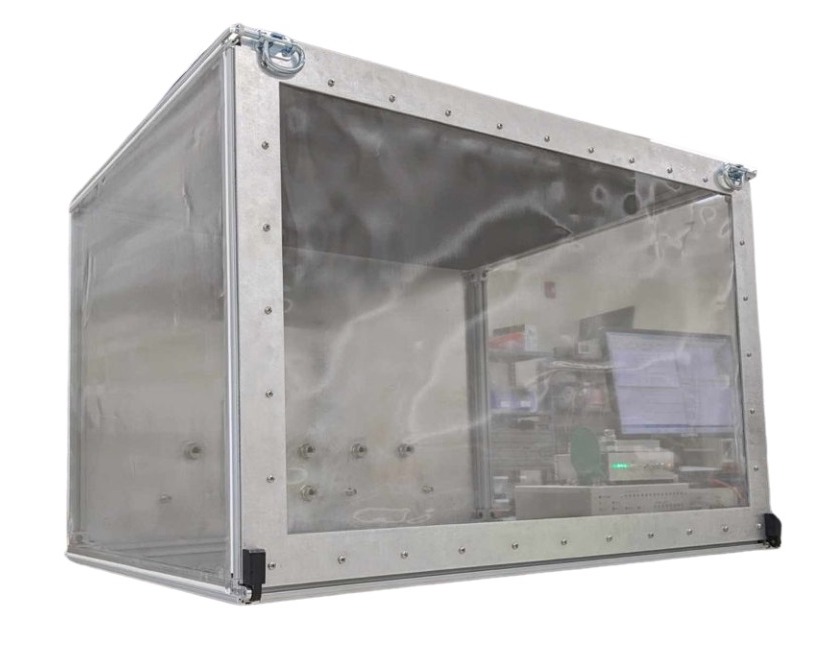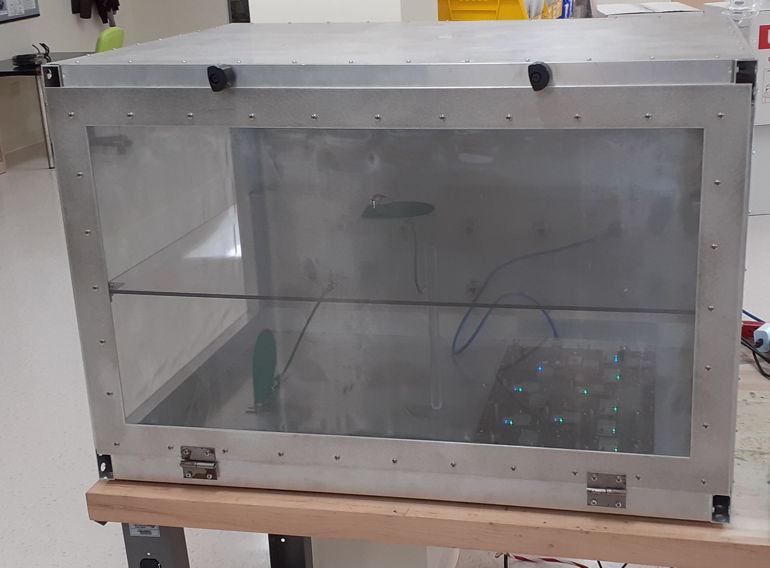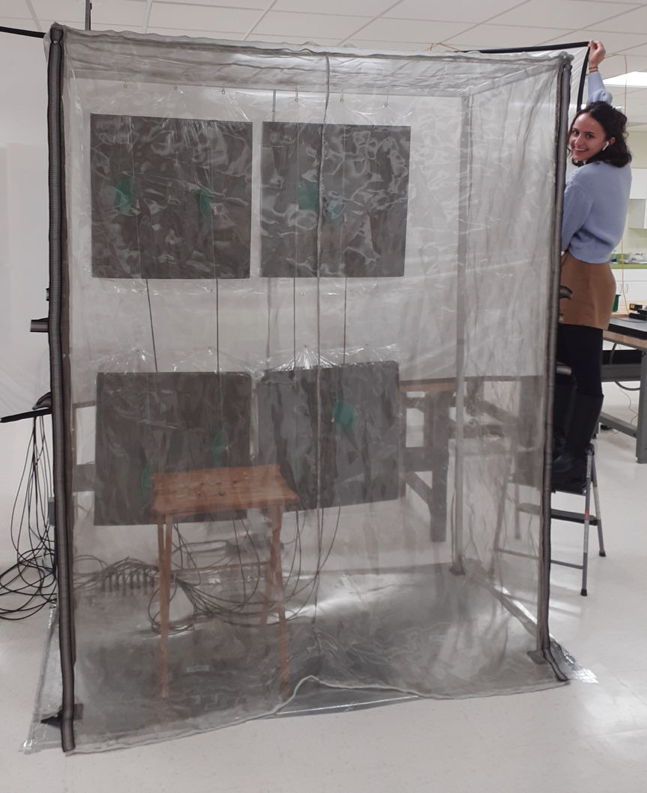
A faraday enclosure is an enclosure with electrically conducting walls. Electromagnetic waves cannot pass through a conducting wall, so an enclosure with conducting walls stops electromagnetic waves from either entering or leaving the enclosed space. We are interested in the application of faraday enclosures in our system of Subcutaneous Transmitters for the following reasons.
Our Subcutaneous Transmitter (A3013) transmits −4 dBm (For an explanation of dBm and other radio-frequency terms, see our Terminology Page, −4 dBm is 400 μW.) This power is spread across a 10-MHz band centered on the 902−928 MHz ISM band. (The ISM band is a license-free band in the US and UK.) We detect the A3013A signal with a Loop Antenna (A3015A) plugged into a Data Receiver (A3018A). When the antenna is 100 cm from the transmitter, our signal is attenuated by at least 32 dB (see Reception). When the two antennas are unfavorably oriented, we can suffer another 17 dB attenuition (see Omni-Directional Antennas). With conducting surfaces nearby, we can suffer another 10 dB loss due to multi-path interference (see Multi-Path Interference and Radiated Power). We can end up receiving only −63 dBm from our original −4 dBm (500 pW of the original 400 μW).
For proper reception, our signal power must be 12 dB higher than the total ambient interference power in the ISM band (see Foreign Interference). Ambient interference (which we have elsewhere called foreign interference) in our basement laboratory is −68 dBm (see Noise and Interference). Our received signal must be at least −56 dBm for guaranteed reception at ranges up to 100 cm. But our received signal can drop as low as −63 dBm. What we find is that we get good reception in 95% of orientations positions at range 100 cm. We call that robust reception and we say our operating range is 100 cm.
As a rule of thumb, therefore, −68 dBm interference allows robust reception up to 100 cm. By applying the inverse-square law of power transmission, we estimate that our operating range will drop to 25 cm when ambient interference rises to −56 dBm.
Our operating range in the ION animal laboratory in London appeared to be 50 cm in 2008. But in early 2009 we find that the range has dropped to 25 cm. A 25-cm operating range is barely adequate for the monitoring a single animal cage. Looking back on the ambient interference spectra we obtained in the ION animal laboratory in 2006 (see Interference), we see one peak 15 dB above our spectrometer's noise floor and a series of smaller peaks at 10 dB above. We did not know it at the time, but the spectrometer's noise floor is −80 dBm (see Power Calibration), so the largest peak is at −65 dBm and the others are at −60 dBm. If we integrate the power over the ISM band, we arrive at ambient interference of roughly −56 dBm (give or take a few dBm, but −56 dBm corresponds to 25 cm operating range). To increase the operating range to 100 cm, we must either increase our signal power by 12 dBm, or drop the ambient interference by 12 dBm. In this report, we consider how we can drop the interference power seen at the antenna, while leaving the signal power intact.
One way to drop the interference power is with a large, see-through faraday enclosure placed around four animal cages and the receiving antenna. If this faraday enclosure could give us a 12 dB attenuition of the ambient interference, we could receive reliably from all four animal cages.
We offer the following range of faraday enclosures in both kit and assembled form.
| Part | Height (cm) |
Width (cm) |
Depth (cm) |
Description |
|---|---|---|---|---|
| FE1A | 30 | 40 | 30 | electrical test enclosure, all walls steel mesh, absorber in lid, assembled |
| FE2A | 71 | 71 | 42 | for two animals, all walls steel mesh, absorber in lid, assembled |
| FE2B | 71 | 71 | 33 | for two animals, 3 walls mesh, 3 walls sheet, absorber in lid, assembled |
| FE2B-K | 71 | 71 | 33 | for two animals, 3 walls mesh, 3 walls sheet, absorber in lid, kit |
The dimensions we give in the table above are the outer dimensions of the enclosure. The interior width and depth are 1 cm smaller on account of the thickness of the aluminum brackets. The interior height is 6 cm shorter because of the foam absorber on the underside of the lid. The opening at the top of the enclosure is roughly 90 mm smaller on account of the width of the aluminum brackets.
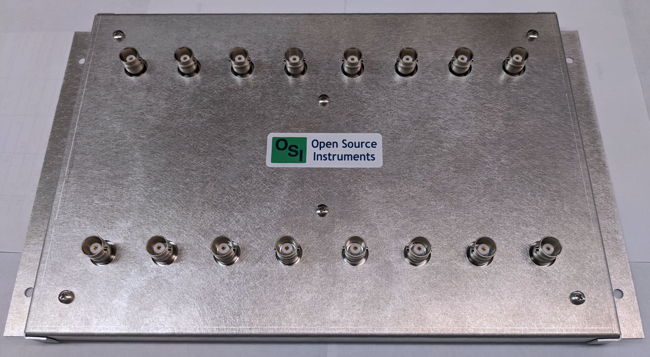
Each faraday enclosure includes an antenna, a cable to connect the antenna to the enclosure's BNC feedthrough connector, and another cable to connect to the receiver or to a combiner. If you want to connect several faraday enclosures to a single receiver, you can use our Four-Way Antenna Combiners (AC4A). The AC4A includes a 30-cm coaxial cable, two 50-Ohm terminators, and a four-way 910-MHz power combiner.
We can provide enclosures with all walls made of steel mesh or with only some walls made of steel mesh. The FE2B has the sides and front made of mesh, while the lid, base, and back wall are made of 0.8 mm (1/32") aluminum sheet.

Our FE2A costs around $200 to ship from the US to the UK. The parts from which it is made, on the other hand, cost about $100 to ship. It takes roughly two hours of labor to assemble a big enclosure, plus use of a meter square of table surface and a bunch of clamps. This two hours of labor is distributed over several days. We charge $200 for construction. You can buy the faraday enclosure in kit form or fully-assembled. We provide a Enclosure Assembly Manual to make it easy for you to duplicate our assembly procedures, or even to improve upon them. For prices of kits and fully-assembled enclosures see here.
We describe how to build a faraday enclosure in our Faraday Enclosure Assembly Manual.
[08-APR-09] We construct two faraday enclosures with the help of cardboard boxes. The first uses aluminum foil as the conducting wall material and the second uses aluminum mosquito screen with 1.5-mm square holes. To test the effectiveness of the enclosures, we set up our 910-MHz SAW Oscillator (A3014SO) 5 m from our RF Spectrometer (A3008) and measured the power received by the spectrometer as we placed it in the enclosures.
| Shielding | Antenna Power |
|---|---|
| Spectrometer Antenna Disconnected | −80 dBm |
| Spectrometer Loop Antenna Unshielded | −48 dBm |
| Foil-Lined Enclosure (poorly-sealed) | −73 dBm |
| Foil-Lined Enclosure (well-sealed) | −76 dBm |
| Aluminum Screen (poorly-sealed) | −56 dBm |
| Aluminum Screen (well-sealed) | −63 dBm |
The power we received depended upon the exact position of the spectrometer, regardless of the shielding. We see a ±1 dB variation as we move the spectrometer by ±10 cm. But it appears that the foil enclosure gives us 28 dB attenuition and the screen enclosure gives us 16 dB. Sealing the foil and screen around the corners and lid of the enclosure is important: poor sealing can case a jump of 10 dB in the power inside the enclosure.

Whatever faraday enclosure we use around our animal cages, it must be transparant and rugged. A foil shield is neither transparant nor rugged. The screen enclosure is both. It gives us 16 dB attenuition, which would drop the estimated −56 dBm ambient interference in the ION laboratory down to −72 dBm, and so increase our operating range there from 25 cm to around 200 cm.
Our aluminum mosquito screen was $1 per square foot. There are better meshes available, such as these. The vendor claims that their VeilShield gives 50 dB attenuition at 1 GHz. They sell it for $3 per square foot and it comes in 58-inch wide rolls.
[09-APR-09] We want to know if reflections inside a faraday enclosure will cause more severe multi-path interference than outide a faraday enclosure. We placed our spectrometer inside the foil enclosure. We attached an encapsulated A3013A to a stick. With the tip of the stick protruding from the enclosure, we rotated and moved the transmitter. The power measured by the spectrometer at the center of the transmitter's spectrum varied from −43 dBm down to −72 dBm. When we perform the same experiment outside the enclosure, the power varies from −33 dBm down to −78 dBm. It appears that our problems with multi-path interference and poor orientation are alleviated in the enclosure. Certainly, they are not exacerbated.
[09-APR-09] We placed the Data Receiver antenna in the foil enclosure. We placed a transmitter outside the enclosure at a range 30 cm from the antenna. We moved and rotated the transmitter. We obtained robust reception. There were precise locations where reception became intermittent. We placed the transmitter in the enclosure and the antenna outside the enclosure at a range of 30 cm from the transmitter. We obtained no reception.
This simple experiment proves that interference is limiting our operating range. Let us consider both stages of the experiment in turn.
When the antenna is in the enclosure, both the signal and the interference are attenuated by the faraday enclosure. Let us assume the faraday enclosure attenuates both signal and interference by 28 dB. The interference power drops to −88 dBm, on a par with the receiver's noise power (which is −90 dBm, see Noise and Interference). Our signal can drop to −4 dBm at the transmitter, −22 dB for 30 cm of air, −17 dB for unfavorable orientation, −10 dB for multi-path interference, −28 dB for the faraday enclosure, which is −80 dBm. Our receiver works down to −76 dBm (see Demodulator). And so reception fails in a few precise orientations of the transmitter outside the faraday enclosure, and is no worse than reception without the faraday enclosure.
When the transmitter is in the enclosure, the signal is attenuated by 28 dB, but not the interference. Even with a precise, favorable orientation of the transmitter, we get no more than −54 dBm at the receiver. Our interference power remains at −68 dBm, so the minimum power required for reception is −56 dBm. When we place the transmitter in a random orientation, we will get far too little power, as little as −81 dBm, for reception. And so we obtained no reception at all the five or six times we placed the transmitter in the foil enclosure and closed the lid.
[09-APR-09] We put a transmitter in a plastic bag and wrapped it in one layer of mosquito screen. We placed it in the foil enclosure with the receiving antenna. We obtained intermittent reception. We opened the enclosure and moved the transmitter, and repeated a few more times. We received anything from a 2% to 50% reception. This suggests that the mosquito screen is attenuating the signal by more than the foil enclosure attenuates the interference. A well-sealed faraday enclosure made of mosquito screen should give us attenuition of 30 dB or more. At ION, such a enclosure would drop the −56 dBm interference down to −86 dBm, and our operating range would jump up to several meters. If we build a faraday enclosure large enough to enclose four animal cages, it would be roughly 100 cm along its longest side. We can hope for prefect reception in all orientations and positions of the transmitter while implanted in an animal.
[13-APR-09] We apply an oscilloscope probe on points in the amplifier of our Demodulating Receiver (A3017). We know the gain of each stage the amplifier so we can convert peak-to-peak amplitude on the oscilloscope into power at the antenna input. We use 29 dB for the gain from RF to IF (see schematic) and 71 dB from RF to the output of U204. Our source of artificial interference was our 910-MHz SAW Oscillator (A3014SO). We put its 13-dBm output through a 20-dB attenuator and into quarter-wave wire antenna.
| Receiver | Transmitter | Amplitude and Point |
Input Power | Comments |
|---|---|---|---|---|
| none | none | 80 mV p-p @ U204 | −86 dBm | input noise |
| terminator and 1-m cable | none | 100 mV p-p @ U204 | −84 dBm | cable pick-up |
| anntenna and 1-m cable | none | 600 mV p-p @ U204 | −68 dBm | ambient interference bad message rate 3/s |
| antenna in foil enclosure enclosure not grounded |
none | 130 mV p-p @ U204 | −82 dBm | attenuition 14 dB |
| antenna in foil enclosure enclosure grounded and squeezed |
none | 80 mV p-p @ U204 | −86 dBm | attenuition >18 dB |
| antenna and 1-m cable | −7 dBm, 910 MHz, 100 cm | 130 mV p-p @ IF | −40 dBm | artificial interference |
| antenna in foil enclosure enclosure not grounded |
−7 dBm, 910 MHz, 100 cm | 24 mV p-p @ IF | −54 dBm | attenuition 16 dB |
| antenna in foil enclosure enclosure grounded |
−7 dBm, 910 MHz, 100 cm | 12 mV p-p @ IF | −60 dBm | attenuition 20 dB |
| antenna in foil enclosure enclosure grounded and squeezed |
−7 dBm, 910 MHz, 100 cm | 220 mV p-p @ U204 | −77 dBm | attenuition 37 dB |
| terminator and 1-m cable | −7 dBm, 910 MHz, 100 cm | 200 mV p-p @ U204 | −78 dBm | cable pick-up |
| antenna in foil enclosure | A3013A at 10 cm in enclosure | 350 mV p-p @ IF | −31 dBm | 100% message reception |
| antenna in foil enclosure enclosure grounded |
A3013A at 10 cm in enclosure −7 dBm, 910 MHz, 100 cm |
350 mV p-p @ IF from A3013A 12 mV p-p @ IF from 910 MHz |
−31 dBm −60 dBm |
100% message reception |
| antenna and 1-m cable | A3013A at 10 cm −7 dBm, 910 MHz, 100 cm |
350 mV p-p @ IF from A3013A 130 mV p-p @ IF from 910 MHz |
−31 dBm −40 dBm |
0% message reception |
Our power measurements are accurate to ±2 dB. The amplifier gain is temperature-dependent and we must measure peak-to-peak amplitude on the oscillocsope screen. During the course of our experiments, we discovered that grounding the faraday enclosure increased its performance by at least 6 dB. We used a BNC cable union at the point where the antenna cable enters the enclosure, and made sure that contact with copper tape connected the union to the enclosure. This gave us 6 dB more isolation from our 910-MHz interference. When we squeezed the enclosure with our hands, pressing together loose pieces of foil, we obtain up to 18 dB more isolation, bringing the total isolation provided by the enclosure to 37 dB. In the presense of −40 dB of 910-MHz interference, reception from an A3013A at range 10 cm goes from 0% with no isolation to 100% inside our foil enclosure.
[17-APR-09] We repeat some previous experiments with our foil enclosure, and increasing levels of ambient interference. We set up our 910 MHz, +13 dBm source with a 30 dB attenuator and an 80-mm antenna. At range 100 cm we receive −53 dBm with a Loop Antenna (A3015A). We place our antenna in the foil enclosure and receive −77 dBm. The foil enclosure is providing 24 dB isolation. Now we begin our experiments. At each step, we select a smaller attenuator for our 910 MHz source. We assume the ambient 910 MHz power around our enclosure increases in proportion to the decrease in our attenuator. We have the antenna in the foil enclosure connected to our Data Receiver (A3018). We hold a transmitter in the enclosure on a stick. We rotate and move the transmitter for one minute while monitoring with the Recorder Instrument. We calculate average, minimum, and maximum message reception over 1-s periods and record it in the table below.
| 910 MHz Attenuator (dB) |
910 MHz Outside Enclosure (dBm) |
910 MHz In Enclosure (dBm) |
Average Reception (% in 1 s) |
Maximum Reception (% in 1 s) |
Minimum Reception (% in 1 s) |
|---|---|---|---|---|---|
| 30 | −53 | −77 | 98 | 100 | 71 |
| 26 | −49 | −73 | 99 | 100 | 92 |
| 23 | −46 | −70 | 98 | 100 | 83 |
| 20 | −43 | −67 | 97 | 100 | 46 |
| 18 | −41 | −65 | 97 | 100 | 58 |
| 15 | −38 | −62 | 97 | 100 | 32 |
| 12 | −35 | −59 | 91 | 100 | 41 |
| 9 | −32 | −56 | 87 | 100 | 24 |
| 6 | −29 | −53 | 73 | 100 | 1 |
| 33 | −56 | no enclosure | 62 | 100 | 0 |
The foil enclosure allows a 20 cm operating range with up to −32 dBm ambient interference. The enclosure attenuates this −32 dBm to −56 dBm. Inside our foil enclosure, our operating range is 20 cm for −56 dBm of interference at the receiving antenna. We set up our 910 MHz source one meter from a receiving antenna with no faraday enclosure. We added attenuators until the antenna received −56 dBm. We moved our transmitter around between 0 cm and 20 cm of the antenna, and monitored reception. The result is the final line in the table above.
Given the same interference power at the receiving antenna, reception from a subcutaneous transmitter appears to be slightly better inside a faraday enclosure than outside. On average, reflections off the enclosure walls appears to help rather than hinder reception. The dominant effect of a faraday enclosure is to attenuate ambient interference. In today's experiments, we obtained operating range 20 cm with −32 dBm interference outside the enclosure. We can obtain the same operating range without a faraday enclosure only if ambient interference is lower than −56 dBm, or 0.4% of the power we can tolerate with a faraday enclosure.
[29-APR-09] We have our prototype screen-walled faraday enclosure. It measures 40 cm × 30 cm × 30 cm. The frame is made of 1.6-mm thick aluminum angle brackets. The walls are made of stainless steel VeilShield fabric. The fabric is taped to the frame with a variety of metal tapes.

We perform some of the same experiments we did for the foil enclosure, to measure the attenuition of artificial interference by the enclosure. We turn on our 910-MHz transmitter and place our receiving antenna 100 cm away. We place the prototype enclosure around the antenna and make adjustments to its lid and walls.
| Shielding | Received Interference |
|---|---|
| None | −35 dBm |
| No Antenna | −65 dBm |
| Prototype Enclosure | −59 dBm |
| Prototype Enclosure, double Al screen over lid | −59 dBm |
| Prototype Enclosure, lid off | −41 dBm |
| Prototype Enclosure, double Al screen under lid | −59 dBm |
| Prototype Enclosure, single Al screen in front | −60 dBm |
| Prototype Enclosure, double Al screen in front | −60 dBm |
| Prototype Enclosure, double Al screen on left | −61 dBm |
| Prototype Enclosure, single Al screen front and left | −64 dBm |
| Prototype Enclosure, single Al screen front, right, and left | −66 dBm |
| Prototype Enclosure, single Al screen front, right, top, and left | −65 dBm |
| Prototype Enclosure, single Al screen in front | −59 dBm |
| Prototype Enclosure | −59 dBm |
The prototype enclosure on its own provides roughly 24 dB attenuition of interference. With extra layers of shielding on the sides, we can improve attenuition to 30 dB. Our experiment is not sensitive to further improvements.
| 910 MHz Outside Enclosure (dBm) |
Average Reception (% in 1 s) |
Maximum Reception (% in 1 s) |
Minimum Reception (% in 1 s) |
Comments |
|---|---|---|---|---|
| −68 | 76 | 100 | 12 | RA outside enclosure, 10-mm TA in hand, range ≤40 cm |
| −68 | 99 | 100 | 93 | RA 10 cm from corner, 10-mm TA in hand, enclosure lid off |
| −68 | 88 | 100 | 41 | RA 10 cm from corner, 10-mm TA on stick, enclosure lid off |
| −68 | 100 | 100 | 96 | RA 10 cm from corner, 50-mm TA in hand, enclosure lid off |
| −68 | 96 | 100 | 74 | RA 10 cm from corner, 10-mm TA on stick, enclosure closed |
| −68 | 89 | 100 | 39 | RA 10 cm from corner, 50-mm TA on stick, enclosure closed |
| −68 | 79 | 100 | 36 | RA 10 cm from corner, 30-mm TA on stick, enclosure closed |
| −68 | 99 | 100 | 82 | RA at floor center, 30-mm TA on stick, enclosure closed |
| −68 | 96 | 100 | 71 | RA at floor center, 50-mm TA on stick, enclosure closed |
| −35 | 77 | 100 | 14 | RA at floor center, 50-mm TA on stick, enclosure closed |
| −35 | 48 | 100 | 0 | RA at floor center, 10-mm TA on stick, enclosure closed |
| −68 | 97 | 100 | 40 | RA at floor center, 50-mm TA in fake rat, enclosure closed |
| −35 | 81 | 100 | 5 | RA at floor center, 50-mm TA in fake rat, enclosure closed |
| −49 | 98 | 100 | 78 | RA at floor center, 50-mm TA in fake rat, enclosure closed |
| −35 | 40 | 100 | 0 | RA at floor center, 20-mm TA in fake rat, enclosure closed |
| −49 | 77 | 100 | 0 | RA at floor center, 20-mm TA in fake rat, enclosure closed |
We simulated implanting the transmitter in a rat body by tying a latex glove filled with water to our stick, as shown below.

One thing that stands out from our observations is that the receiving antenna performs better at the center of the enclosure than in the corner.
[12-JUN-09] Reception is poor inside our Big Enclosure. We observed sharp holes in reception with frequency, which we believe are caused by internal reflections within the enclosure. Today we looked at the reception with frequency for the prototype enclosure. The result is the oscilloscope shots below.


Although we see holes in the reception with frequency, they are not nearly as sharp nor as deep as those we see in the same traces for the Big Enclosure.
[05-MAY-09] Pishan at ION (Institute of Neurology) made her own faraday enclosure out of foil and a cardboard box. She placed an animal cage within the foil enclosure. The animal cage contained a rat with an A3013A implanted transmitter. She put an A3015A loop antenna inside the enclosure with the animal and the cage. The antenna was close to one wall, so as to make space for the cage. The cable shield was not connected to the foil around the box.
The foil enclosure blocked out all signals from transmitters outside the enclosure. Reception from the transmitter inside the enclosure was 85% in one test and 91% in another. Reception outside the enclosure with these same transmitters was 95% and 80% respectively.

Because the antenna is close to a wall of the box, we expect reception to drop from 100% to 90%, as it did when we moved the antenna into the corner of our prototype enclosure. But we expected reception outside the enclosure to be poorer, so as to give a contrast with the reception inside the enclosure. On this day, however, reception from both tested transmitters was good outside the enclosure. We will see what happens on other days.
[07-MAY-09] Pishan put the antenna in the center of the enclosure and released each of four animals into the enclosure in turn, like this. We received 0% from transmitters outside the enclosure, except when No12 was in the enclosure and No1 was outside, when we received 14% from No1 through the foil walls. Reception from No12 inside the enclosure was 93%. We saw 100% reception most of the time, but occasional seconds would go by with 0% reception. This loss contrasts with the loss we observe outside the enclosure, where reception is 30% to 90% all of the time. Reception from No10 was 94% in the enclosure, from No9 was 84%, and from No1 was 96%.
[10-JUN-09] Today we completed our first large faraday enclosure, which we call our Big Enclosure. The big enclosure is 70 cm × 70 cm × 40 cm, and is large enough to fit two animal cages and their water bottles with room to spare. As in our prototype enclosure, the walls of the bix enclosure are made of VeilShield fabric and its edges are made of 1.6-mm aluminum L-brackets. The lid has been simplified, so that it takes up less height. We describe the construction of the big enclosure in our Assembly Manual.

We set up a 910-MHz interference source and obtained the following power at our receiving antenna as we moved the antenna in and out of the enclosure, put on the lid, and sealed up gaps beneath the lid with aluminum slats.
| Shielding | Received Interference |
|---|---|
| None | −44 dBm |
| No Antenna | −82 dBm |
| Big Enclosure, original lid | −57 dBm |
| Big Enclosure, lid gaps sealed | −68 dBm |
| Big Enclosure, adjust lid | − 82 dBm |
| Big Enclosure, adjust lid | − 73 dBm |
| Big Enclosure, adjust lid | − 63 dBm |
With the gaps in the lid reduced with aluminum slats, the enclosure gives a minimum of 20 dB isolation, and with perfect lid adjustment, up to 40 dB isolation. The 20 dB variation in isolation with lid position is affected also by the location of the experimenter's bodies, and contact with the fabric walls.
We place a transmitter in the enclosure. We get good reception with the lid off, but when we put the lid on, we get no signal. We move the transmitter. We get a week signal. We continue with these movements and observations, and find that reception inside the enclosure is poor, although it is unaffected by turning on our external 910-MHz transmitter. We supposed that internal reflections in the big enclosure would be less severe than in the prototype enclosure, which was half the length and one tenth the volume. But we appear to have been mistaken.
We inserted a second loop antenna into the big enclosure and powered it with our Modulating Transmitter (A3014MT). We sweep the frequency of the transmitter through the 900−930 MHz band. We observe the IF amplitude in our Demodulating Receiver (A3017). This amplitude is proportional to the product of the power received by our antenna and the loss in our SAW band-pass filter. We obtained the following measurements with our oscilloscope.


With the 30dB attenuator, we see the response of the SAW filter in our receiver. With the two loop antennas and the lid off, we see a similar frequency response, with no notches. As soon as we put the lid on, the notches appear. As we move the antennas around, adjust the lid, and press upon the walls, the notches move around rapidly, and form complex patterns. Often the notches join up and we get holes in the frequency response. With a quarter-wave transmitting antenna, the holes become more severe.
With its highly reflective walls, and its dimensions greater than one wavelength of our signal, the big enclosure is a resonant chamber in which standing waves form as a matter of course, and destructive interference almost always occurs at one frequency or more frequencies in the 900−930 MHz band. We estimate that the narrow reception holes are as deep as 30 dB, so that we are suffering a 30 dB loss of power at one particular frequency because of multi-path interference.
We placed baffles made of mosquito screen in the corners of the enclosure. We observed fewer holes in the frequency response, but still enough to compromise reception from our transmitters. All we can do with our reflecting screens is re-direct the waves. But we observe that we get good performance inside the enclosure when we take the lid off. Radio waves leaving the top of the enclosure don't come back, or hardly any of them do. Removing the lid is equivalent to placing a microwave absorber in the lid. We removed the lid and moved a transmitter into all parts of the enclosure, including the corners, and rotated it rapidly and at random for sixty seconds. We obtained 98% message reception. With an absorber in the lid, we would obtain the same performance, so we are confident that such an absorber will solve our reflection problems.
[12-JUN-09] We repeated our interference measurements for the Prototype Enclosure. You will find our observations in the Prototype Enclosure section. We do not see sharp holes in reception with frequency. Our observation is consistent with our claim that it is the sharp holes that destroy reception of our transmitter signals. We conclude that internal reflections, leading to standing waves and other interference phenomena, take place far more easily in the Big Enclosure than the Prototype Enclosure. The Big Enclosure has sides that are a little over two wavelengths long. The Prototype Enclosure has sides that are one wavelength long.
[19-JUN-09] We received two 61-cm × 61-cm pieces of Eccosorb microwave absorbant foam. The AN-75 is 3 cm thick and the AN-77 is 6 cm thick. The black surface of the AN-75 reflects only 4% at 900 MHz, and the AN-77 reflects only 2%. What is not reflected is absorbed. Each foam pad consists of three layers of carbon-impregnated conducting layers. We placed the foam in the enclosure, either on the bottom or attached to the lid, and measured reception with a transmitter on a stick for each arrangement. We are delighted with our results.
| Foam Arrangement | Average Reception (%) |
|---|---|
| No foam | 33 |
| AN-77 on bottom, black side up, antenna 25 cm from wall | 94 |
| AN-77 on bottom, black side up | 95 |
| AN-77 on bottom, black side up | 97 |
| AN-75 on bottom, black side up | 93 |
| AN-75 on bottom, black side down | 91 |
| AN-75 under lid, black side down | 97 |
| AN-75 under lid, black side down | 96 |
| No foam, lid off | 90 |
| No foam, lid off, −40dBm 910 MHz outside | 35 |
| AN-75 under lid, black side down, −40dBm 910 MHz outside | 93 |
| AN-75 10 cm below lid, black side down, −40dBm 910 MHz outside | 83 |
| No enclosure, −40dBm 910 MHz outside | 0.3 |
| No enclosure | 88 |
| AN-77 beneath antenna, black side up, no enclosure | 89 |
| AN-77 on top of lid, black side down | 18 |
| AN-75 under lid, black side up | 95 |
| AN-77 on bottom, black side down | 97 |
| AN-77 on bottom, black side up, AN-75 under lid, black side down | 96 |
| AN-75 on bottom, black side up | 85 |
| AN-75 glued under lid, black side up, AN-77 on bottom, black side up | 97 |
| AN-75 glued under lid, black side up | 87 |
| AN-75 glued under lid, black side up, antenna 10 cm above bottom | 87 |
| No foam | 52 |
| AN-77 on bottom, black side down | 88 |
| AN-77 on bottom, black side up | 98 |
| AN-77 on bottom, black side down | 89 |
| AN-77 on bottom, black side up | 98 |
| AN-75 on bottom, black side up | 91 |
| AN-75 on bottom, black side down | 81 |
| AN-75 on bottom, black side up | 92 |
| AN-77 glued under lid, black side down | 98 |
| AN-75 on bottom, black side up | 96 |
| No foam | 64 |
| Carbon Sheet, 1 layer on bottom | 81 |
| Carbon Sheet, 2 layers on bottom | 81 |
| Carbon Sheet, 10 bottom | 82 |
| Carbon Sheet, 8 bottom, 1 left and right | 94 |
| Carbon Sheet, 2 bottom, 1 left, right, front, back | 98 |
| AN-75 on bottom, black side up | 97 |
We looked at the reception versus frequency traces on the oscilloscope, and saw no sign of sharp notches or dead spots whenever we had one of the pieces of absorbant foam in the enclosure. We can find orientations when reception across the 902−908 MHz spectrum is greatly reduced, but these reductions can be explained by the relative orientation of the transmitting and receiving antennas alone.
We turned on 910 MHz interference power and compared the power we receive inside and outside the Big Enclosure when we have the AN-77 foam sitting on the bottom, with the antenna on the foam at the enclosure center. Received power dropped from −44 dBm to anything between −74 dBm and −80 dBm as we moved the lid around and changed the position of our own body. We conclude that the Big Enclosure, when equipped with absorbant foam, gives us 30-dB isolation. If keeps out 99.9% of all RF power in our spectrum.
Reception inside the Big Enclosure is better than reception outside, even when we don't generate our own interference.
[25-JUN-09] We glued the AN-75 (3 cm) black side up on the underside of a new lid. The lid does not perform well. We get only 87% reception. We repeat our experiments with the AN-77 (6 cm), flipping it from black side up to black side down. The black side is the conducting side, which is suppose to be the last layer of foam reached by an absorbed wave. Our understanding, and that of the manufacturer of the foam, suggests we will get best performance with the black side facing the enclosure boundary. In previous experiments, we noticed little difference between the orientations. At that time, our test transmitter battery voltage was above 2.5V. But today the voltage is down to 2.3V. With the weaker transmission power, the difference between the foam orientations is clear and repeatable. The enclosure performs better with the black side facing away from the enclosure boundary.
We removed the AN-75 from the lid, where it had been glued securely, and placed it in the bottom of the enclosure. We obtained 91% reception with the black side up, and 81% with the black side down. We resolve to glue the AN-77 black side down to the lid, and try again.
[29-JUN-09] With the AN-77 (6 cm) glued to the lid, black side down, we get 98% reception from our test transmitter, whose battery voltage is now 2.1V. We will ship this faraday enclosure to ION.
[08-JUL-09] We have some microwave aborbant sheet made of carbon fibers. This material is only half a millimeter thick. It costs $30 per square meter. We placed layers of the sheet in the bottom of the enclosure and tested reception. One layer in the bottom improves reception from 64% to 81%. Multiple layers do nothing to improve reception. With one layer of sheet on the bottom and four side walls, we obtain 98% reception.

[15-JUL-09] Pishan at ION has implanted transmitter No11 in a rat, put the rat in a plastic cage, and put the plastic cage within a big enclosure we sent to ION by air freight. Over the course of five minutes, with the rat moving around, she obtained an average of 99% reception, with reception of at least 80% of messages during 98% of the three hundred seconds, and a minumum reception during one particular second of 53%. This is the best reception we have ever obtained from a transmitter, implanted or not, in Boston or London. We conclude that the Big Enclosure with the 6-cm absorber is effective.
[01-SEP-09] We return from a visit to ION. Reception from two animals in a single faraday enclosure remains perfect. You can see the two animals here. Pishan tells us she would like the enclosure to be 10 cm shorter so that she can lean into it more easily. The back side of the lid has broken off and remains held in place by aluminum tape. The glue joints broke on both sides and the small brackets fell off. We fixed a hole in the mesh walls with tape.
[08-JUL-09] Our hope is that we can connect multiple faraday enclosures to a single receiver, by combining the signals received from the antenna in each enclosure. We connected our Big Enclosure and our Prototype Enclosure to a single Data Receiver (A3018). In the Big Enclosure we had an AN-75 foam absorber, black side up in the bottom. In the Prototype Enclosure we placed a single thickness of microwave absorbant sheet. We moved a transmitter around in the Big Enclosure and kept a transmitter in the Prototype Enclosure in a jar of water. We tried various ways of combining the signals.
| Antenna Junction | Reception in Prototype Enclosure (%) |
Reception in Big Enclosure (%) |
|---|---|---|
| T-Junction Only | 100 | 97 |
| Two 3dB Attenuators | 100 | 98 |
| Two 6dB Attenuators | 99 | 96 |
| Two 12dB Attenuators | 100 | 93 |
| Two 18dB Attenuators | 100 | 79 |
| T-Junction Only, −40 dBm Outside | 100 | 40 |
| Two 3dB Attenuators, −40 dBm Outside | 100 | 67 |
| T-Junction Only, −40 dBm Outside | 100 | 37 |
| Two 3dB Attenuators, −40 dBm Outside | 99 | 83 |
| T-Junction Only, −40 dBm Outside | 100 | 64 |
| Two 6dB Attenuators, −40 dBm Outside | 100 | 91 |
| Two 12dB Attenuators, −40 dBm Outside | 100 | 94 |
| T-Junction Only, −40 dBm Outside | 100 | 81 |
| T-Junction Only, −40 dBm Outside | 99 | 79 |
| ZB4PD1-2000+ Combiner | 98 | 99 |
| ZB4PD1-2000+ Combiner, −40 dBm Outside | 93 | 100 |
The results with no attenuators, just a T-junction joining the two antenna cables, and outside interference at 910 MHz, are varied. We obtained between 37% and 81% reception. But the improvement in reception with attenuators in the presence of interference is significant. We obtained 94% reception from the moving transmitter with 12 dB attenuators and −40 dBm interference.
[09-SEP-09] We combine the antenna signals with the help of a Four-Way Antenna Combiner (AC4A), which consists of a ZB4PD1-2000 four-way power combiner and two BTRM-50 fifty-ohm terminators, all from Minicircuits. The transmitter in the jar in the prototype enclosure has been running continuously since 08-JUL-09, and it's battery voltage has dropped to 2.2 V. We are not surprized that reception drops to 93% in the presence of interference. But the transmitter in the big enclosure has a brand new battery. Reception is 100% even with interference.
The advantage of the combiner is that signals from one input do not travel out along the other inputs. Each antenna is isolated from the other, even as their signals are added in the combiner. There is a power loss of −6 dB in a 4-way combiner, but our eariler experiments revealed that attenuition of up to 12 dB does little to degrade reception.
We package the combiner, two terminators, and a 30-cm BNC cable in our Four-Way Antenna Combiner (AC4A). Connect two or more antennas to the input sockets on the power combiner. Cover any unused sockets with terminators. Connect the output socket on the combiner to the receiver input.
[05-NOV-09] We assist with the completion of an FE2B enclosure at ION and set up two cages with an antenna combiner. There are two animals in one cage and one in another (No6, No14, and No5 respectively). We place two transmitters in bags upon the floor of one cage (No1 and No2), to assure a weak signal, and a third on top of a cage (No3). Transmitter No6 has been showing problems with reception for some time. We obtain the following graph.

We see that the combination of two cages is effective.
[07-DEC-09] At ION, reception from two enclosures with the AC4A has been poor, as you can see in the second table of the Trials section in Flexible Wires. Some transmitters show average reception of 50%. Today, Pishan connected one enclosure at a time to a Data Receiver (A3018) and reception rose for all transmitters to 98% or higher. We resolve to repeat our experiments with antenna combiners in our own lab.
| Antenna Junction | Reception (%) |
|---|---|
| Single Enclosure, Direct, Q0126, 3 cm Foam | 98% (entire volume) |
| Single Enclosure, Direct, Q0126, 3 cm Foam | 90% (corners and walls) |
| Single Enclosure, Direct, Q0126, 6 cm Foam | 99% (entire volume) |
| Single Enclosure, Direct, Q0126, 6 cm Foam | 99% (corners and walls) |
| Single Enclosure, Combiner, Q0126, 6 cm Foam | 99% (entire volume) |
| Single Enclosure, Combiner, Q0126, 6 cm Foam | 97% (corners and walls) |
| Two Enclosures, Combiner, Q0126, 6 cm Foam | 99% (entire volume) |
| Two Enclosures, Combiner, Q0126, 6 cm Foam | 98% (corners and walls) |
| Two Enclosures, Combiner, P0193, 6 cm Foam | 100% (entire volume) |
| Two Enclosures, Combiner, P0193, 6 cm Foam | 99% (corners and walls) |
| Two Enclosures, Combiner, P0193, 6 cm Foam | 96% (entire volume), 98%, 98%, 99% (stationary) |
| Two Enclosures, Combiner, P0193, 6 cm Foam | 98% (entire volume), 96%, 97%, 100% (stationary) |
| Two Enclosures, Combiner, P0193, 6 cm Foam, −40dBm outside | 90% (corners and walls), 99%, 99%, 100% (stationary) |
| Two Enclosures, Lids Off, Combiner, P0193, 6 cm Foam, −40dBm outside | 0% (corners and walls), 0%, 0%, 0% (stationary) |
| Two Enclosures, Lids Off, Combiner, P0193, 6 cm Foam, −40dBm outside | 0% (entire volume), 0%, 0%, 0% (stationary) |
| Two Enclosures, Lids Off, Combiner, P0193, 6 cm Foam | 99% (entire volume), 98%, 99%, 101% (stationary) |
In these tests, we introduce the exploration of "corners and walls" of an enclosure as compared to the "entire volume". In the past, we have explored the entire volume, spending only a quarter of the time close to the corners and walls. In our new "corners and walls" tests, the transmitter spends its entire time touching or almost-touching the corners and walls. Thus we obtain a more conservative measure of signal loss.
The RF ampligier in the Data Receiver (A30138) has a tendancy to oscillate. We try two receivers: Q0126 and P0193, to see if one of them will show instability with the antenna combiner. But both receivers perform well with the combiner.
We see the faraday enclosures isolating the transmitters from external −40dBm interference. When we remove the lids, reception drops to zero. With the −40dBm removed, reception is good with the lids off, although we see evidence of bad messages from ambient −68dBm interference. When we have multiple transmitters, two are in the second enclosure.
We cannot reproduce the poor reception observed at ION.
[21-MAY-09] We measure the mains hum on free-floating transmitter leads inside and outside our prototype faraday enclosure. We see 2 mV p-p hum outside and less than 20 μV of hum inside the enclosure. When we put the enclosure's lid on, we see the following signal on the transmitter's X input.

We conclude that the faraday enclosure gives us a factor of 100 drop in mains hum amplitude, or 40 dB attenuition.
[20-JUL-09] In France, where our 902−928 MHz band is used by cell phones, we observed interference of −48 dBm (see Interference). That's 20 dB greater than the interference in our basement laboratory, where our operating range is 100 cm. If we were to attempt to use the 902−928 MHz band in France, our operating range without a faraday enclosure would be only 10 cm.
We made a faraday enclosure with an aluminum frame and steel mesh walls. The antenna cable passes through the frame with a BNC feedthrough. The enclosure measures 70 cm × 70 cm × 40 cm. It is large enough to fit two plastic animal cages, with room to spare for the water bottles. On the underside of its lid is a 6-cm thick 61-cm wide square of microwave-absorbant foam. This enclosure gives us a minimum of 30 dB isolation, meaning that it blocks 99.9% of external interference power. The microwave absorbant foam dampens internal reflections of transmitter signals and also absorbs interference power that manages to penetrate the enclosure walls. Without the foam, the enclosure acts as a resonant cavity in the 902−928 MHz band. When the enclosure resonates with a transmitter signal, the signal interferes with itself, causing large reception dead spots. When the enclosure resonates with external interference, the interference lingers and builds up in the enclosure, compromising its powers of isolation.
With our 71 cm × 71 cm × 42 cm faraday enclosure, ION obtained an average of 99% receptioni from a transmitter implanted in an active rat. Outside the faraday enclosure, reception from implanted transmitter can be as low as 25% at the same range. Our hope was to provide a subcutaneous transmitter system that received over 80% of messages 95% of the time. In this case, we receive over 80% of message 98% of the time.
We can combine the signals arriving from multiple faraday enclosures, and feed them into a single receiver. The combined signal provides robust reception of all transmitters in the enclosures. We propose a system of four faraday enclosures, each of which contains two animals in their own plastic cages. Each faraday enclosure contains one antenna. We combine the four antenna signals our Four-Way Antenna Combiner (AC4A) and feed the combination into a Data Receiver (A3018). The Data Receiver is in turn connected to a LWDAQ Driver (A2037E). One such system supports continuous data reception from eight transmitters with transfer of the data over the internet to a data-logging computer. The data rate for such a system would be around 16 kBytes/s (512 samples per second per transmitter × 4 bytes per sample × 8 transmitters). Within this eight-animal system, each transmitter must have its own unique channel number. Our transmitter messages support channel numbers 1 through 14.
Any number of these eight-transmitter systems can occupy the same laboratory space, assuming the space is large enough to accommodate all the enclosures. The arrangement of faraday enclosures will ensure that transmitters from one system do not interfere with those in another system. Because each system will have its own internet connection for data transfer, there will be no loss of performance as we add new systems.
We propose to make the faraday enclosure an integral part of the subcutaneous transmitter system. We will provide assembled enclosures and also parts kits so that our users can assemble the enclosures themselves. Self-assembly saves shipping costs and avoids damage to the enclosure during shipping. The assembled 71 cm × 71 cm × 33 cm enclosure, for example, is part number FE2B. The parts kit for the same enclosure is part number FE2B-K. Our assembly instructions provide step-by-step instructions for gluing and taping together a faraday enclosure from a parts kit. For prices, see our price list.