 A3054 Intraperitoneal Transmitter (IPT) Manual
| Description |
| Versions |
| Analog Inputs |
| Electrode Impedance |
| Temperature Sensor |
| Activity and Motion |
| Battery Life |
| Product Comparison |
| Operation |
| Design |
[21-SEP-26] The A3054 Intraperitoneal Transmitter (IPT) is an encapsulated telemetry sensor designed for implantation in the peritoneal cavity of a mouse or a rat. Its pill-shaped, silicone-coated body is designed to be held in place with sutures. The A3054 provides three unipolar biopotential inputs that share the same reference potential, a single bipolar biopotential input, an accelerometer, a thermometer, and an operating life counter. It wakes up and goes to sleep with the application of a magnetic field. The A3054 can programmed to tansmit any combination of measurements from its available sensors, and at a variety of sample rates and bandwidths. The A3054 comes in two versions: programmable and long-life. The A3054P Programmable IPTs we can re-programmed at any time through their wireless command receivers. The new program we upload to an A3054 will be will be persistent from one waking period to the next. The A3054L Long-Life IPT cannot be re-programmed in the field, but provides longer operating life than the A3054P Programmable IPT.
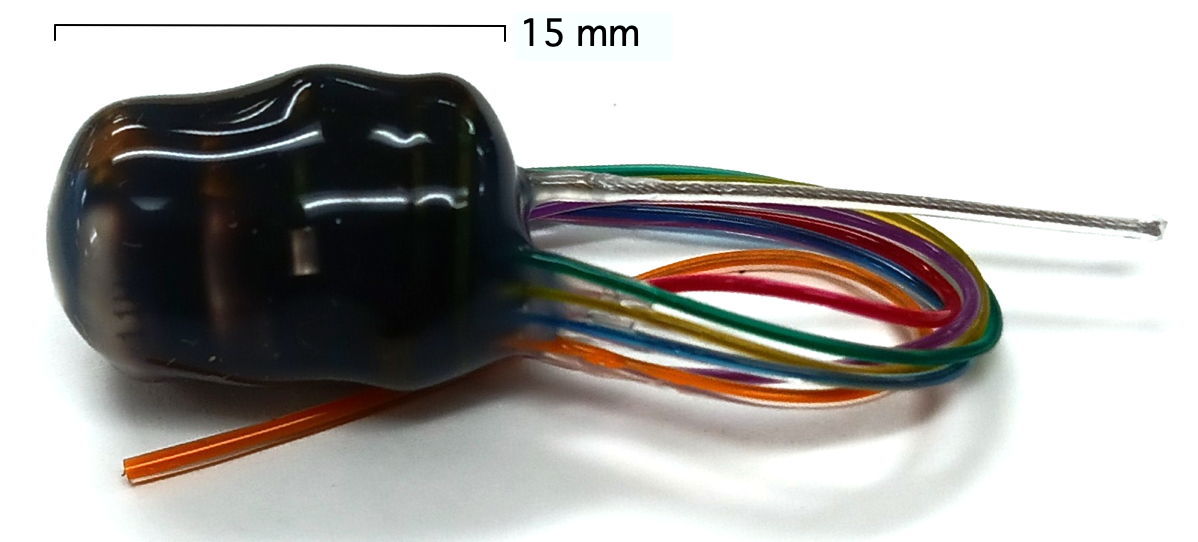
The A3054P Progammable IPT is intended for acute experiments that must be begun at short notice, and also for exploratory experiments in which we determine how best to perform a long-term experiment. If we keep a dozen programmable IPTs on the shelf, we can respond immediately to an urgent request for an acute experiment. We program the IPTs to suit the acute experiment and implant the same day. When we are designing a long-term experiment, the programmable IPT allows us to try a variety of measurement programs so as to make the best compromise between operating life and sensitivity. Once we have determined the optimal configuration for a long-term experiment, and assuming the duration of the experiment is too great for our A3054P Programmable IPTs, we order A3054L Long-Life IPTs for the experiment itself, each long-life IPT programmed to our specifications. To determine the operating life of all versions of A3054 with any combination of measurements, see the Battery Life chapter of this manual.
The A3054's three unipolar inputs can be configured collectively for AC or DC recording. When configured for AC recording, the input dynamic range is ±15 mV, and when configured for DC recording, the input dynamic range is ±56 mV. The unipolar inputs can be either disabled individually or configured individually for transmission sample rates 32, 64, 128, 256, 512, and 1024 SPS (samples per second), for which the signal bandwidths are 12, 25, 50, 100, 200, and 400 Hz respectively. These three unipolar inputs are optimized for recording intracranial electroencephalogram (iEEG), in particular for detecting seizures, inter-ictal spikes, spreading depolarization, and delta waves. The A3054's bipolar input is always DC-coupled. It can be configured with and without digital low-pass filtering, and it can be assigned the same selection of sample rates and bandwidths as the unipolar inputs. The bipolar input is designed for tracing the electrocardiogram (ECG), following electrogastrogram (EGG), and measuring the amplitude of electromyogram (EMG). The A3054's accelerometer can be disabled, or it can be configured to provide an animal activity measurement derived from its on-board accelerometer. The A3054's temperature sensor can be disabled, or it can be configured to provide a body temperature measurement with an absolute accuracy ±0.05°C.
| Name | Color | Function |
|---|---|---|
| X1 | Red | Unipolar X1 input, positive side |
| X2 | Purple | Unipolar X2 input, positive side |
| X3 | Orange | Unipolar X3 input, positive side |
| GND | Blue | Analog ground, X1-X3 negative side |
| X4+ | Yellow | Bipolar X4 input, positive side |
| X4− | Green | Bipolar X1 input, negative side |
| A | Clear | Antenna |
The A3054P Progammable IPTs provide a mechanism for measuring the impedance of its three unipolar biopotential electrodes. Upon receipt of an impedance measurement instruction from a command transmitter, the A3054P applies a voltage step to its unipolar input reference potential. Assuming the reference potential electrode is of lower impedance than the unipolar input electrode impledances, the size of the step we see on each unipolar input will be a function of its electrode impedance and the amplifier's input impedance. The A3054P can measure electrode impedance with a precision of 2.5 kΩ rms.
When you receive an A3054, it will be asleep. When sleeping, the A3054 consumes less than one microamp from its battery as it watches for the presence of a magnetic field. When you bring a magnet near to the sleeping A3054, it wakes up, flashes its indicator lamp, and starts executing its telemetry protocol. The telemetry protocol tells the A3054 which measurements to perform and how to transmit them. We can upload a new telemetry protocol to the A3054P Programmable IPTs by means of wireless commands provided we have a Telemetry Control Box (TCB) equipped with command transmitters, such as the A3042B-series instruments. The A3042A instruments do not include command transmitters, and so are not capable of re-programming an A3054P. If your telemetry receivers are not equipped with command transmitters, you can order long-life A3054L IPSs with a telemetry protocol that suits your experiment, and so relieve yourself of the need to program your IPTs, while at the same time enjoying longer battery life.
| Property | Specification |
|---|---|
| Volume | 1.6±0.1 ml |
| Mass | 3.4±0.2 g |
| On-Off Control | magnet |
| Lead Dimensions | diameter 0.5±0.1 mm, length 50±2 mm |
| Lead Terminations | steel coil, diameter 0.25 mm, length 1.0 mm |
| Biopotential Inputs | 3 × unipolar, 1 × bipolar |
| Input Impedance | 500 kΩ |
| Impedance Measurement Precision | 5 kΩ |
| Sample Rates | 32, 64, 128, 256, 512, 1024 SPS |
| Passband Bottom | 0.0 or 0.2 Hz |
| Passband Top | 25, 50, 100, 200, or 400 Hz. |
| Noise | ≤3 μV rms |
| Distortion | <0.1% |
| Dynamic Range | unipolar: DC ±56 mV, AC ±15 mV, bipolar: DC ±45 mV |
| Sample Resolution | 16-bit |
| Absolute Maximum Input Voltage | ±3 V |
| Battery Capacity | 3500 μA-days |
| Shelf Life | 12 months |
| Operating Life | 24 days with 3×0.0-100 Hz iEEG, 1×0.0-100 Hz EMG, temperature |
| Operating Life | 45 days with 1×0.2-100 Hz iEEG, temperature, activity |
Each time the A3054 boots up and reads its telemetry protocol from memory, it calculates a protocol checksum that identifies the protocol and it reads from non-volatile memory the number of hours it has been awake. Once every few minutes, the A3054 transmits the square root of the number of hours for which it has been awake and transmits the telemetry protocol checksum as well. Once every hour, it records its hour-counter to non-volatile memory so that it can be recalled if we put the IPT to sleep. The IPT uses the auxiliary channels supported by our telemetry system to transmit these timekeeping and checksum messages. The Telemetry Manager component of our free and open-source LWDAQ Software receives and decodes these auxiliary message, both when we are watching a live telemetry data, or when we are replaying an recording of telemetry data. The Telemetry Manager also allows us to transmit commands to A3054P Programmable IPTs. Using the Telemetry Manager we can upload a new telemetry protocol, stop and start the telemetry protocol, and reboot an A3054P's microprocessor.
| Property | Specification |
|---|---|
| Impedance Measurement Precision | Not Available |
| Operating Life | 61 days with 3×0.0-100 Hz iEEG, 1×0.0-100 Hz EMG, temperature |
| Operating Life | 123 days with 1×0.2-100 Hz iEEG, temperature, activity |
| Shelf Life | 12 months |
The A3054 is the first of our second generation of telemetry sensors, the first generation being the A3019, A3028, A3047, A3048, and A3049 Subcutaneous Transmitters (SCTs). We have the first encapsulated A3054P Programmable IPT in hand. All sizes of the A3054P Programmable IPT will be available to order in August 2026. The A3054L Long-Life IPTs are still in development. The 3054L will be the first implant to deploy our new and more efficient radio-frequency transmitter. We expect the first encapsulated A3054Ls to be ready to ship in January 2027.
[22-JUL-26] We define the following part numbers for versions of the A3054 Intraperitoneal Transmitter (IPT). The part numbers begin with "A3054". After that comes a letter that specifies the batteries that power the device, which in turn dictates its battery capacity. The next letter is "P" for programmable versions and "L" or long-life versions. This letter is not included in the version table because it does not affect the battery capacity, mass, volume, or shelf life of the device. We will not use the letters "P" or "L" to specify batteries, so we can refer to programmable A3054s collectively as "A3054P" and long-life versions as "A3054L". The L and P option affects only the operating life and progrmmability of the IPT. We refer you to the Battery Life chapter of this manual for a calculator that will estimate the operating life of any version of A3054 with any configuration.
| Version | Battery Capacity (μA·d) |
Volume (ml) |
Mass (g) |
Shelf Life (mo) |
|---|---|---|---|---|
| A3054A | 1100 (2×SR916) | 1.2 | 2.1 | 4 |
| A3054B | 1900 (2×SR920) | 1.3 | 2.4 | 6 |
| A3054C | 2500 (2×SR927) | 1.5 | 3.1 | 8 |
| A3054D | 3500 (2×SR936) | 1.6 | 3.4 | 12 |
| A3054E | 5000 (2×SR43) | 2.1 | 4.5 | 17 |
| A3054F | 6700 (2×SR44) | 2.5 | 5.6 | 17 |
The shelf life of the A3054 Intraperitoneal Transmitter is the time it takes to use up 10% of the battery capacity when the device is asleep on the shelf. The operating life is how long the device can produce reliable measurements when starting with a fresh battery. The operating life depends upon the telemetry protocol. In particular, it depends upon the total number of samples per second the telemetry protocol transmits. The the Battery Life chapter for more details.
[19-OCT-26] The A3054 has four analog inputs: three uniploar and one bipolar. The unipolar inputs are designed for iEEG recording. The bipolar input is suitable for EMG, EEG, or ECG recording. We can enable or disable any combination of inputs. The unipolar inputs are the X1 (red), X2 (purple), and X3 (orange). These share the same reference potential GND (blue), which we define to be 0 V, so we refer to the unipolar voltages as simply X1, X2, and X3. The biplar input is X4P (yellow) and X4N (green), and the voltage measured is X4 = X4P − X4N. The X1-X3 inputs can be configured collectively for AC or DC recording. When configured for DC recording, all three unipolar inputs are sensitive down to DC (0.0 Hz) and their dynamic range is ±56 mV. When configured for AC recording, they are sensitive down to 0.2 Hz with dynamic range ±15 mV. The bipolar X4 input is always DC-coupled with dynamic range ±45 mV.
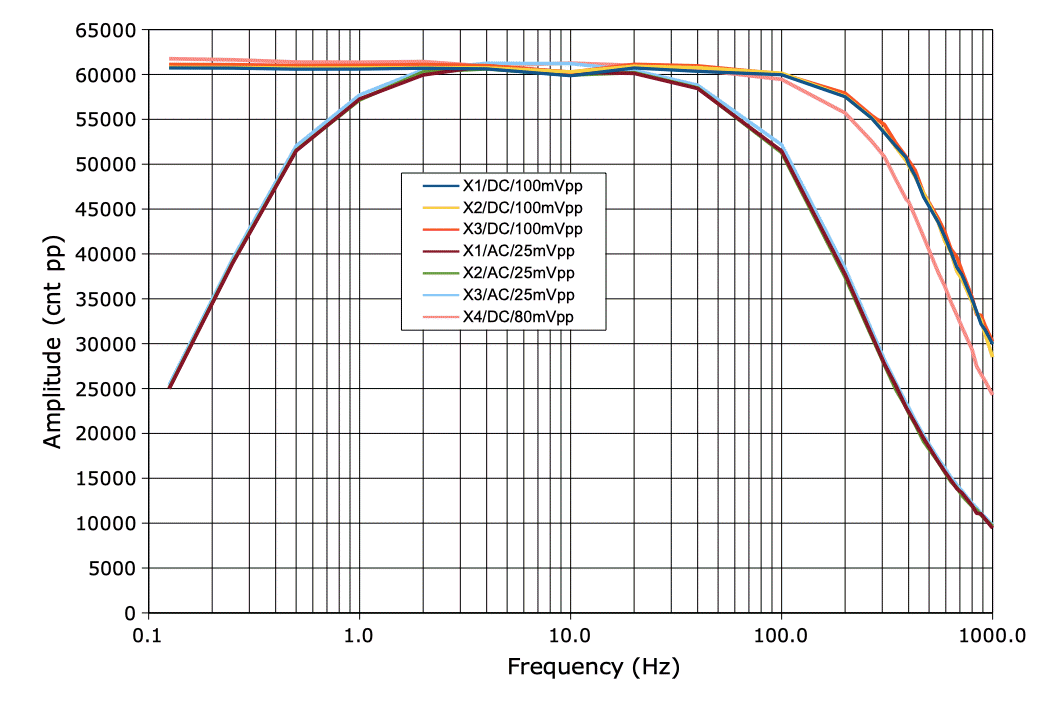
The A3054 amplifiers provide gain and built-in low-pass filtering. The low-pass filtering reduces aliasing distortion. The corner frequency of this low-pass filter is around 500 Hz for X1-X3 amplifiers with DC-coupling, 130 Hz for the X1-X3 amplifiers with AC-coupling, and 400 Hz for the X4 amplifier, which is always DC-coupled. The A3054 samples the low-pass filtered output from each amplifier at 1024 SPS. This sample rate is adequate to represent signals up to 512 Hz, but higher-frequency signals will suffer from aliasing distortion, whereby they appear in the digitized signal as signals of a lower frequency. The ideal low-pass filter would remove all signals above 512 Hz before sampling, but none of our filters are ideal. The 500-Hz low-pass filter of the DC-coupled X1-X3 amplifiers attenuates 1 kHz only by a factor of two compared to 100 Hz. The 130-Hz low-pass filters of the AC-coupled X1-X3 amplifiers provide sufficient attenuatiuon to eliminate aliasing distortion, but if we want to record signals in the range 200-500 Hz, this filter will attenuate their amplitude. The 400-Hz low-pass filter of X4 is somewhere in between.
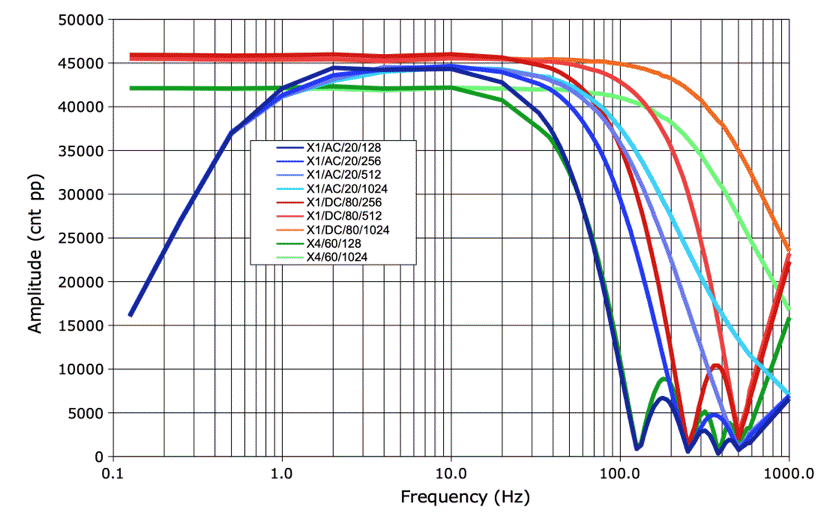
The A3054 amplifier low-pass filters are not sufficient to eliminate aliasing noise at frequencies above 500 Hz, but for the biopotentials the A3054 is designed to record, this failure to eliminate distortion of frequencies above 500 Hz does not cause any significant loss of signal fidelity. The unipolar inputs, X1-X3, are designed to record iEEG, which is a signal with very little power above 200 Hz. We do not have to worry about aliasing distortion in iEEG when we are sampling at 1024 SPS. We will have some higher-frequency electrical noise generated within the A3054 circuit, and the 500-Hz and 130-Hz low-pass filters serve to reduce the amplitude of this electrical noise prior to sampling. The X4 input is designed for EMG, EGG, or ECG. The EMG signal is a chaotic waveform with significant power in the range 40 Hz to 600 Hz. But we don't want to record the shape of the EMG signal, we just want to measure its amplitude, and aliasing distortion does not change the signal amplitude. When measuring EMG amplitude, we have no need of a low-pass filter at all. In the EGG signal, we will be using DC coupling, and the power above 400 Hz is far smaller than the slow-moving gut signals we are looking for, so aliasing will be insignificant. In the ECG signal, we have a fundamental harmonic in the range 5-20 Hz accompanied by harmonics all the way up to 200 Hz, but not much above that. The rest of the ECG signal is chaotic and wide-band, so aliasing will not distort our pattern of ECG spikes. Despite the fact that the A3054 does not provide aggressive anti-aliasing filters, its high sample rate serves to render aliasing distortion insignificant for the signals it is designed to record.
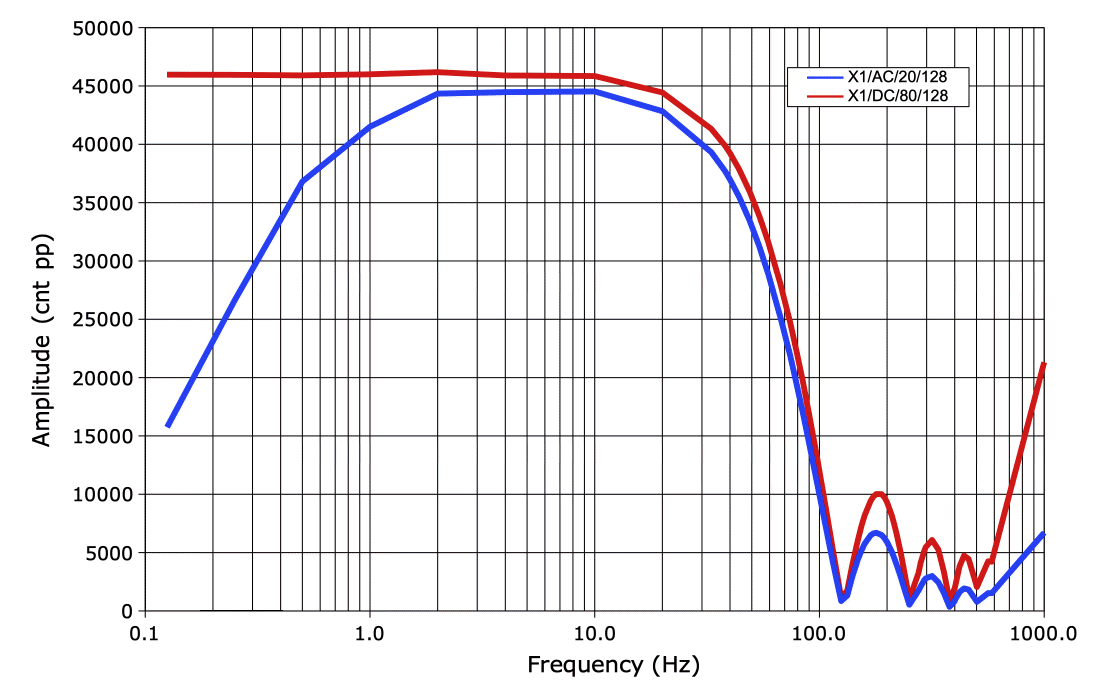
Averaging filters provide a sharp cut-off above their corner frequency, but at slightly higher frequencies, they exhibit rebounds in their response that we do not see in analog low-pass filters. Consider the frequency response of X1 with DC coupling at 128 SPS, as shown here. The averaging filter for 128 SPS is taking eight 1024 SPS samples, adding them together, and dividing by eight to produce each of the 128 SPS samples. This averaging reduces the amplitude of a 50-Hz sinusoid to 75% and the amplitude of a 100-Hz sinusoid to 20% of the amplitude in the middle of the amplifier's passband. At 128 Hz, the amplitude approaches zero, but then rebounds to a maximum of 23% at 185 Hz, which is a frequency at which tan(πf/128) = 8 * tan(πf/1024). There are further rebounds at 316 Hz (15%) and 445 Hz (13%). We claim that these rebounds have no significant effect upon the appearance of biopotential signals. We used our Averaging Filter Simulator to compare signals before and after the application of averaging filters. This simulator is a Neuroplayer interval processor. Download the processor and select in the Neuroplayer to examine the example iEEG recordings provided with the LWDAQ distribution. The processor allows us to see how baseline and ictal iEEG appears after averaging 2, 4, 8, 16, or 32 samples of the original signal. We are unable to see any effect other than effective low-pass filtering.
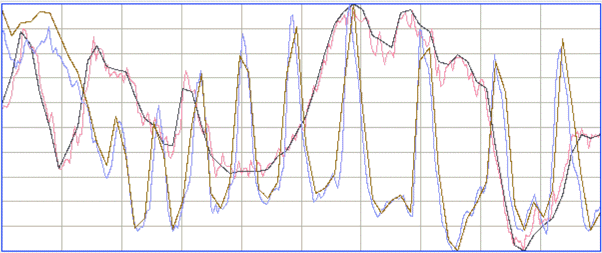
Although all enabled inputs are sampled at 1024 SPS, they do not have to be transmitted at 1024 SPS. They can each be transmitted at any of the sample rates 64, 128, 256, 512, or 1024 SPS. When transmitted at less than 1024 SPS, the A3054 transmits the average of the samples accumulated between transmissions. By means of this averaging, the A3054 provides low-pass filtering for all four analog inputs as required to avoid aliasing distortion at the lower sample rates. The averaging filters provide a sharp initial drop in response above their corner frequency, followed by distinctive rebounds in response at higher frequencies. For sample rates 32, 64, 128, 256, and 512 SPS, these averaging filters provide bandwidths 12, 25, 50, 100, and 200 Hz respectively.
| Input | 32 SPS | 64 SPS | 128 SPS | 256 SPS | 512 | 1024 |
|---|---|---|---|---|---|---|
| X1-X3 AC-Coupled ±15 mV | 0.2-12 Hz | 0.2-25 Hz | 0.2-50 Hz | 0.2-100 Hz | 0.2-130 Hz | 0.2-130 Hz |
| X1-X3 DC-Coupled ±56 mV | 0.0-12 Hz | 0.0-25 Hz | 0.0-50 Hz | 0.0-100 Hz | 0.0-200 Hz | 0.0-500 Hz |
| X4 DC-Coupled ±45 mV | 0.0-12 Hz | 0.0-25 Hz | 0.0-50 Hz | 0.0-100 Hz | 0.0-200 Hz | 0.0-400 Hz |
| X4 DC-Coupled ±45 mV SS | 0.0-400 Hz | 0.0-400 Hz | 0.0-400 Hz | 0.0-400 Hz | 0.0-400 Hz | 0.0-400 Hz |
When DC-coupled, the X1-X3 dynamic range is ±56 mV, which is almost four times the ±15 mV AC-coupled dyanmic range. The AC-coupled amplifier must provide almost four times the gain, and because of that, its bandwidth is almost four times less: 130 Hz instead of the DC-coupled amplifier's 500 Hz. If we want to record frequencies higher than 130 Hz, we must configure X1-X3 for DC-coupling. The noise on the DC-coupled inputs is slightly higher than the AC-coupled inputs, but remains less than 10 μV at the full 500-Hz bandwidth. The noise in any biopotential spanning 500 Hz will be far higher than 10 μV, so the A3054's DC-coupled inputs provide high-fidelity recording of all frequencies 0.0-500 Hz when sampled at 1024 SPS. The ±56 mV dynamic range of the DC-coupled inputs is wide enough to accommodate all galvanic potentials generated by stainless steel electrodes, as well as any slow biopotentials generated by mice and rats.
The electrical noise on the A3054 biopotential inputs is the noise we observe in the transmitted signal when we place the battery-powered circuit in a Faraday enclosure and connect each input to its reference potential with 100 kΩ, or we take a fully-encapsulated circuit and drop it into a beaker of water. This noise is the noise generated by the amplifiers and converters in the A3054 circuit. The higher the sample rate, the higher the bandwidth of the signal and the higher we expect the noise amplitude to be. We expect the noise amplitude to increase approximately as the square root of the bandwidth. Some of the noise generated by the circuit occurs after amplification. This post-amplification noise makes a more significant contribution to the total noise when the dynamic range of the input is larger. When DC-coupled, the X1-X3 input dynamic range is ±56 mV compared to the AC-coupled range of ±15 mV. We therefore expect the DC-coupled input noise to be greater than the AC-coupled input noise.
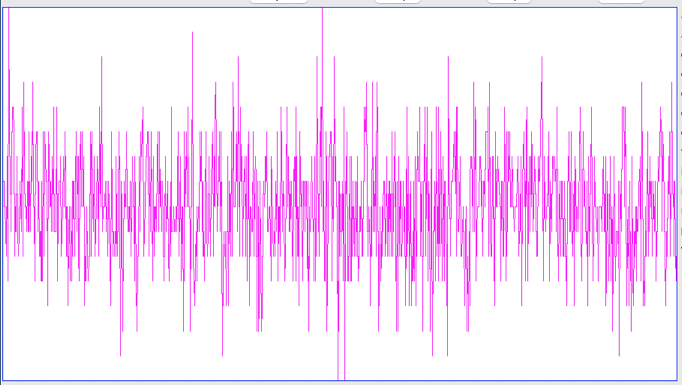
The electrical noise on the A3054 biopotential inputs contains no random spikes and its spectrum shows no sustained peaks. So far as we can tell, the noise is stochastic. As a result, we express A3054 input noise as a root mean square amplitude that we express in units of sixteen-bit counts or microvolt. With DC-coupling and 1024 SPS the noise on X1-X3 is around 15 μV, while with AC-coupling it is 5 μV. When we drop the sample rate to 256 SPS, for which our bandwidth is 100 Hz, the DC-coupled noise is 7 μV and the AC-coupled noise is 3 μV. We see that the AC-coupled signals suffer from less noise, but even the DC-coupled noise is far below the noise amplitude present in any iEEG, EMG, ECG, or EGG signal we have encountered. We suspect that DC coupling will be adequate for all biopotential recordings.
| Configuration | X1 (cnt) | X2 (cnt) | X3 (cnt) | X4 (cnt) | X1 (μV) | X2 (μV) | X3 (μV) | X4 (μV) |
|---|---|---|---|---|---|---|---|---|
| DC, 1024 SPS | 8.6 | 8.4 | 8.6 | 8.1 | 14.7 | 14.4 | 14.7 | 11.1 |
| AC, 1024 SPS | 10.2 | 10.5 | 10.2 | 8.5 | 4.7 | 4.8 | 4.7 | 11.7 |
| DC, 512 SPS | 6.1 | 6.1 | 5.9 | 6.1 | 10.4 | 10.4 | 10.1 | 8.4 |
| AC, 512 SPS | 8.1 | 7.9 | 7.6 | 6.4 | 3.7 | 3.6 | 3.5 | 8.8 |
| DC, 256 SPS | 4.1 | 4.3 | 3.7 | 4.6 | 7.0 | 7.3 | 6.3 | 6.3 |
| AC, 256 SPS | 6.1 | 6.0 | 5.8 | 4.2 | 2.8 | 2.7 | 2.7 | 5.8 |
| DC, 128 SPS | 3.4 | 3.4 | 2.9 | 2.9 | 5.8 | 5.8 | 5.0 | 4.0 |
| AC, 128 SPS | 4.8 | 4.7 | 4.2 | 3.1 | 2.2 | 2.2 | 1.9 | 4.3 |
| DC, 64 SPS | 2.2 | 2.3 | 2.1 | 2.1 | 3.8 | 3.9 | 3.6 | 2.9 |
| AC, 64 SPS | 3.9 | 3.3 | 3.5 | 2.1 | 1.8 | 1.5 | 1.6 | 2.9 |
When we record iEEG and ECG, the spectrum of the signal and the shape of its features are important to us. We detect seizures in iEEG, for example, by looking for coherent spikes, and we measure heart rate in ECG by finding the fundamental frequency of the ECG signal. For these signals, and for EGG as well, we want to filter out frequencies higher than half our sample rate so as to reduce aliasing distortion and preserve the shape of the voltage signal. Because the power of these signals drops dramatically with frequency above 10 Hz, attenuating higher frequencies with a filter does little to distort or attenuate the amplitude of the signal we want to record. The EMG signal, however, contains very little power below 20 Hz, and substantial power throughout the range 40 Hz to 600 Hz. If we want to obtain a strong EMG signal, we should retain these higher frequency components. One option is to connect EMG to X4 and sample and transmit X4 at 1024 SPS. We will obtain a faithful and powerful recording of EMG with this high sample rate. But we will also be consuming more power from our battery, which will reduce the operating life of our A3054. Most often, the only feature of the EMG signal that we are interested in is its amplitude. We might be measuring EMG amplitude to determine whether or not an animal is asleep. In order to measure the amplitude, we do not need 1024 SPS. We can make do perfectly well with 64 SPS. The A3054 provides a single sample mode of operation for the X4 in which the averaging filter is turned off. Instead of accumulating samples between sample transmissions, only one sample is taken and transmitted. We can configure X4 to transmit at 64 SPS in single-sample mode and we will get an EMG signal that suffers from severe aliasing distortion, but nevertheless retains the correct amplitude. By transmitting at 64 SPS rather than 1024 SPs we reduce the current consumption of X4 transmission by a factor of sixteen.
[22-JUL-26] The A3054P Programmable ISTs provide a means for measuring the impedance of the X1-X3 unipolar input electrodes. The Telemetry Manager provides Zon and Zoff buttons for each IPT in its device list. During normal operation, all IPTs should be in the Zoff state, where the amplifier ground is connected directly to the GND input. When we send the Zon command, the A3054 connects its GND input to −7.14 mV. If the X1, X2, X3, and GND electrode impedances are all small compared to the 500-kΩ input impedance of the X1-X3 amplifiers, we will see a +7.14 mV step up in the X1, X2, and X3 signals. If we see a step up of half that amount in, for example, the X1 input, then the combined impedance of the GND and X1 electrodes is half of 500 kΩ, or 250 kΩ. If we can assume that the GND electrode has been secured to the skull in such a way as to provide a low-impedance ground connection to the animal body, then the impedance between the GND and X1 inputs to the A3054 is dominated by the impedance of the X1 electrode, and the same will be true for X2 and X3. The electrode impedance makes a voltage divider with the input impedance of the amplifier, which we know to be 500 kΩ, and so the voltage step we observe in each input provides us with a measurement of its input impedance, according to the following formula.
Where Z is the combined impedance of GND and our unipolar input electrodes, R_in is the amplifier input resistance, V_test is 7.14 mV, and V_step is the size of the step we observe on the unipolar signal. The accuracy of this measurement is limited by the accuracy with which we know the gain of our amplifiers, which is around 2%, and the precision of the measurement is limited by noise to around 0.5% of the R_in, which is 2.5 kΩ. The single bipolar input has its own reference potential and so should be unaffected by a shift in the unipolar ground potential. We cannot, therefore, measure the impedance of the bipolar electrodes. Nor can we measure impedance with the A3054L Long-Life IPTs, which provide no means for receiving a Zon or Zoff command.
[22-JUL-26] The A3054 Intraperitoneal Transmitter is equipped with a TMP117 temperature sensor. This sensor is accurate to ±0.05°C. When we enable the A3054's temperature sensor, the A3054 transmits its temperature measurement on a dedicated telemetry channel that we specify during configuration. The temperature signal is updated at 2 Hz and transmitted at 32 SPS. The temperature signal itself consists of sixteen-bit samples, each between 0 and 65535, where 32768 is 0.000°C. Each count represents a 7.8125 mK change in temperature. Each 128 counts is 1°C. Thus 37.00°C is 37504 cnt and 60.00°C is 40448 cnt.
| T (°C) | T (cnt) | T (°C) | T (cnt) | T (°C) | T (cnt) |
|---|---|---|---|---|---|
| 20 | 35328 | 37.0 | 37504 | 0.0 | 32768 |
| 21 | 35456 | 37.1 | 37517 | 5.0 | 33408 |
| 22 | 35584 | 37.2 | 37530 | 10.0 | 34048 |
| 23 | 35712 | 37.3 | 37542 | 15.0 | 34688 |
| 24 | 35840 | 37.4 | 37555 | 35.0 | 37248 |
| 25 | 35968 | 37.5 | 37568 | 40.0 | 37888 |
| 26 | 36096 | 37.6 | 37581 | 45.0 | 38528 |
| 27 | 36224 | 37.7 | 37594 | 50.0 | 39168 |
| 28 | 36352 | 37.8 | 37606 | 55.0 | 39808 |
| 29 | 36480 | 37.9 | 37619 | 60.0 | 40448 |
To convert from A3054 temperature samples to centigrate, we subtract 32768 and multiply by 0.0078125°C. To illustrate how we can watch the Receiver Instrument for a temperature signal on a channel of our choosing, and convert the signal to temperature in a graphical user interface, see our Temperature Gauge example program, or ask the OSI Chatbot to write a Neuroplayer interval processor to add temperature to your telemetry interval characteristics.
[17-AUG-26] The A3054 Intraperitoneal Transmitter is equipped with a BMA400 three-axis accelerometer. This device provides orthogonal x, y, and z-coordinate acceleration measurements with dynamic ranges from ±2g m/s/s to ±16g, where g = 10 m/s/s is the Earth's gravitational acceleration at sea level. The accelerometer can be configured with measurement update rates from 0.78 Hz to 400 Hz. We can enable any or all of the x, y, and z-coordinate accelerations for transmission. All accelerometer signals will be transmitted at the same sample rate. Each signal receives its own telemetry channel. For the purpose of illustration, we define two modes of operation: "activity monitoring" and "movement recording". In activity monitoring, we have one signal that fluctuates as the animal moves. In movement recording we have three signals that allow us to estimate the direction and distance moved by the animal in the coordinate system of the accelerometer.
The accelerometer is useful as an activity monitor not only because it measures the acceleration of the animal with respect to its cage, but also because it measures changes in the orientation of the animal with respect to the vertical. A laboratory mouse can jump approximately 30 cm straight up if startled, implying a take-off speed of 2.5 m/s, which they achieve in about 100 ms. Their acceleration can therefore be as high as 25 m/s/s, which is a little over 2 g, where g = 10 m/s/s is Earth's gravitational acceleration at sea level. But mice do not spend much of their time accelerating anywhere close to g as they explore their cages. The most significant acceleration signal comes from the rotation of the accelerometer coordinates with respect to the acceleration due to gravity.
The configuration of the A3054 that we recommend for activity monitoring is the x-direction acceleration updating transmitted at 32 SPS. For a 32 SPS transmission, we configure the accelerometer to update at 25 Hz. The x-direction is perpendicular to the cylindrical axis of the pill-shaped A3054 body. When the x-direction of the accelerometer is horizontal, the x-acceleration due to gravity is zero. When it is downwards, the acceleration is +g. When it points upwards, the acceleration due to gravity is −g. The signal we see as a mouse ambulates around its cage, or grooms itself of one of its companions, is the a variation in the coincidence of the x-direction and the vertical. If we take an A3054, activate activity monitoring, hold it with its axis horizontal and rotate it about its axis, we will see the activity signal going up and down. If we lay it on a bench top and spin it, the angle between the x-axis and the vertical will not rotate, but it will wobble as the transmitter body spins. We will see a rapid oscillation in the activity signal at the frequency of the spin. We recommend ±2 g dynamic range for activity monitoring, which ensures a clear view of orientation changes and sensitivity to slow ambulation.
The configuration of the A3054 that we recommend for movement recording consists of three telemetry signals on three separate telemetry channels, carrying the x, y, and z-coordinate accelerations, each transmitted at 128 SPS. At this sample rate, the A3054 will configure its accelerometer to update its measurements at 100 Hz, which is sufficient to see the movement of a mouse as it ambulates around a cage. We will get 100 samples each second with new measurements and 28 samples per second with repeat measurements. The three channels give us the acceleration of the animal in the coordinate system of the A3054 body. The z-direction is along the axis of the A3054's cylindrical shape and the x and y directions are in the plane perpendicular to the axis. We recommend ±16 g dynamic range for movement recording, to make sure we see all movements without saturation.
[17-AUG-26] When the A3054 Intraperitoneal Transmitter is asleep, it consumes less than 1 μA from its battery. We send it to sleep and wake it up with a magnet. When awake it consumes at the very least its quiescent current, I_q. For programmable A3054Ps, this quiescent current, I_q, is roughly 40 μA at 37°C. For the long-life A3054L versions, I_q is roughly 15 μA at 40°C. When executing a telemetry protocol, the A3054 consumes current sampling, digitizing, and transmitting its four biopotential inputs, assuming at least one of the is enabled. If we enable acceleration or temperature signals, these will consume additional current. The active current of the A3054P Programmable IPTs and A3054L Long-Life IPTs are approximated by the following two equations.
Where I_a is the active current in microamp A3054, Nx is the number of enabled X1-X4 inputs, Tx_max is the maximum transmit sample rate for any single telemetry channel, Tx_tot is the total transmit sample rate for all telemetry channels, Ra is the readout rate of the accelerometer in which each coordinate is read out separately, and Rt is the the readout rate of the temperature sensors. The following calculator combines the above equations with the characteristics of a specified A3054 version to obtain estimates of active current and operating life for any possible telemetry protocol. In the calculation of operating life, the calculator assumes fresh batteries when the telemetry protocol is first activated. The calculator asks us to specify the sample rates for the analog inputs X1-X4, which will be one of 32, 64, 128, 256, 512, and 1024 SPS. To see how these sample rates correspond to signal bandwidths, consult the Analog Inputs chapter of this manual.
The active current, I_a, of an IPT is the sum of all terms in our active current equation, including the quiescent current. The quiescent current, I_q, is the only term that is temperature-dependent. For the A3054P Programmable IPT, the quiescent current is 33 μA at 23°C and 40 μA at 37°C. For the A3054L Long-Life IPT, I_q is 12 μA at 23°C and 15 μA at 37°C. The A3054P and A3054L devices both keep track of the amount of time for which they have been awake: every hour they are awake, they update their non-volatile wake-time counter. Every minute that they are awake, they transmit their wake-time counter using a pair of auxiliary messages. These wake-life messages will be detected and reported by the Telemetry Manager, whether we are watching life data or replaying recorded data.
[17-AUG-26] It is impossible to compare with confidence the performance of our A3054 Intraperitoneal Transmitters with those of our competitors. Our competitors do not provide sufficiently-detailed specifications for us to make a confident comparison. No competitor provides, for example, plots of gain versus frequency for their biopotential inputs. Nor do they provide a spectrum of their input noise. Pamphlets presenting the specification of telemetry sensors sometimes confuse sample rate with bandwidth, so that "100 Hz" is in fact "100 SPS" and we are left wondering what the actual bandwidth of the signal might be. The one thing that the specifications do provide, however, is measurements of volume and mass, and a claim of operating life. Here we attempt to compare the operating life of our A3054 IPTs to devices of similar volume manufactured by our competitors. We do not accept for comparison devices that run on wireless power because wireless power delivery is incompatible with the recording of high-fidelity iEEG: wireless power is rectified by the metal-saline electrode interfaces and turns into movement artifact of order several millivolt. We do, however, accept for comparison devices that operate only with single-housed animals, although we point out that the A3054 IPT works equally well with single or co-housed animals.
| Measurement | Competitor Device | Competitor Volume, Mass |
Competitor Life (day) |
A3054 Version |
A3054 Volume, Mass |
A3054L Life (day) |
A3054P Life (day) |
|---|---|---|---|---|---|---|---|
| Temperature, Activity, Solitary | TA-F10 by DSI | 1.1 ml, 1.6 g | 180 | A3054A | 1.2 ml, 2.1 g | 61 | 22 |
| 1×iEEG, Temperature, Activity, Solitary | ETA-F10 by DSI | 1.1 ml, 1.6 g | 60 | A3054A | 1.2 ml, 2.1 g | 39 | 14 |
| 2×iEEG, Temperature, Activity, Solitary | HD-X02 by DSI | 1.7 ml, 2.2 g | 45 | A3054A | 1.2 ml, 2.1 g | 41 | 11 |
| Temperature, Activity | SoHo-X00 by DSI | 1.5 ml, 2.6 g | 105 | A3054D | 1.6 ml, 3.4 g | 194 | 71 |
| 1×iEEG, Temperature, Activity | SoHo-X01 by DSI | 1.5 ml, 2.6 g | 30 | A3054D | 1.6 ml, 3.4 g | 123 | 45 |
| 2×iEEG, Temperature, Activity | SoHo-X02 by DSI | 1.5 ml, 2.6 g | 30 | A3054D | 1.6 ml, 3.4 g | 90 | 34 |
| Temperature, Activity | SoHo-S00 by DSI | 4.2 ml, 6.0 g | 364 | A3054F | 2.5 ml, 5.6 g | 371 | 136 |
| 1×iEEG, Temperature, Activity | SoHo-S01 by DSI | 4.2 ml, 6.0 g | 126 | A3054F | 2.5 ml, 5.6 g | 135 | 85 |
| 2×iEEG, Temperature, Activity | SoHo-S02 by DSI | 4.2 ml, 6.0 g | 112 | A3054F | 2.5 ml, 5.6 g | 172 | 66 |
| 2×iEEG DC-Coupled | None | Not Applicable | 0 | A3054D | 1.6 ml, 3.4 g | 98 | 37 |
| 3×iEEG, 1×EMG, Temperature, Activity | None | Not Applicable | 0 | A3054D | 1.6 ml, 3.4 g | 59 | 23 |
We would like to compare the costs of implants, but our competitors do not advertise their costs openly. Our IPTs sell for around $800. From the quotations we have seen, the un-discounted cost of ETA-F10 and HD-X02 implants from DSI is around US$6k. We hear that these devices are being retired and replaced by the new SoHo series of devices, but we do not know the price of the SoHo devices. Another important feature of a telemetry system is the number of animals that we can record from with each receiver and the cost per animal of the receiver hardware and software. For OSI telemetry systems, a comfortable estimate is to assume one A3042B-16 Telemetry Control Box (TCB) recording from two IVC racks, each of which contains forty animals, so we have eighty animals per receiver. The cost of the entire system for eighty animals is around $32k, which includes a Faraday canopies for each IVC racks, the TCB, feedthroughs, cables, and antennas. Our software is free and open source. So you will pay a little under $400 per animal for the recording system, followed by $800 per animal for the implants, and nothing more.
[04-SEP-26] All A3054 Intraperitoneal Transmitters wake up and go to sleep with the application of a magnet. When an A3054 is sleeping, its internal circuits are powered down. Programmable A3054s will not respond to commands when they are asleep. The only part of the A3054 that is powered up during sleep is its magnetic sensor and toggle switch. A sleeping A3054 consumes less than 1 μA, typically 0.8 μA. Even A3054s with the smallest batteries can sleep for months and retain 90% of their battery capacity.
When we wake up an A3054 Intraperitoneal Transmitter, it flashes its white indicator light once. The indicator is between the leads and antenna. The flash will be dimly visible through the epoxy encapsulation. The flash begins as soon as the A3054 wakes up and ends when the A3054 finishes configuring itself. During configuration, the A3054 reads its telemetry protocol from its non-volatile memory. It uses the protocol to to configure its sensors, amplifiers, and interrupt routines. Once this configuration is complete, the A3054 turns off its indicator light and starts executing the protocol.
An A3054L Long-Life IPT does not host a command receiver. It cannot respond to wireless commands. Our only control over it is to wake it up or put it to sleep with a magnet. When it is awake, it executes the telemetry protocol it received when it was programmed in our factory. This protocol cannot be altered once the A3054L has been encapsulated. An A3054P Programmable IPT, however, is equipped with a command receiver and will always respond to commands when it is awake. By means of such commands, we upload our own telemetry protocol to its non-volatile memory, reboot the device with a reset command, and the A3054P will immediately load and execute the new protocol. When you first receive an A3054P, its telemetry protocol will be the inactive protocol in which it transmits no measurements on the telemetry signal channels. To upload a new telemetry protocol to an A3045P, we use the Telemetry Manager program, which is a component of our free and open-source LWDAQ Software. The hardware we need to transmit commands to A3054P Programmable IPTs is any member of the A3042B-Series of Telemetry Control Boxes (TCBs). These combined telemetery receivers and command transmitters use the same antennas for both functions.
Each A3054 IPT has a unique factory-assigned four-digit hexadecimal identifier. When we transmit commands to an A3054P Programmable IPT, we use this code to identify a particular A3054P. All A3054Ps within range will parse and examine every command, but only the A3054P with the specified identifier will respond. There is, however, a wildcard ID, 0xFFFF, to which all A3054Ps respond. The identifier of each IPT is given by the four-digit label on the far end of its cylindrical body from its antenna and leads. Even though the A3054L Long-Life IPT has no command receiver, it still has a four-digit identifier. Both the A3054L and A3054P IPTs advertise their identifiers in their regular reporting with auxiliary telemetry messages. The Telemetry Manager will let us know which IPTs are active, whether they are long-life or programmable, by means of these identifiers.
Both A3054L Long-Life and A3054P Programmable IPTs transmit occasional timekeeping and checksum messages using the auxiliary message channels supported by our telemetry system. Within one second of waking up, all A3054 IPTs will transmit one timekeeping and one checksum message. It will repeat transmission of these messages once every few minutes so long as it is awake. Even when an A3054P IPT that is programmed with the inactive protocol will transmit these messages. The timekeeping message contains the eight-bit integer square root of the total number of hours for which the IPT has been awake. This number varies from 0 to 255 and so can measure waking times up to 255 * 255 = 65,000 hours. The checksum message is an eight-bit checksum of the telemetry protocol program, and so acts as an identifier of the protocol. If we know the protocol being executed, we can estimate current consumption and so perform forensic analysis upon telemetry recordings in which IPTs have failed earlier than expected or continued to run longer than expected. The Telemetry Manager program detects these messages in live data arriving from our telemetry receiver, and also in recorded data we are reading back from disk. We note that these auxiliary messages allow the Telemetry Manager to confirm every few minutes that each of our waking A3054L or A3054P IPTs is operational. Even an A3054P executing the inactive protocol, in which it transmits no measurements on telemetry signal channels, will be noticed by the Telemetry Manager by virtue of its auxiliary messages.
The A3054 provides three inputs that share the same reference potential. These are what we call the unipolar inputs, X1, X2, and X3. The unipolar inputs are designed for recording iEEG. Their reference potential, GND, is the ground potential of the sensor, so when we connect GND to the brain, we are grounding the sensor to the animal body. The unipolar inputs can be used with depth electrodes or surface electrodes. The amplifiers run off a 1.80-V power supply and use an internal 0.90-V power supply as their ground potential, so the potential of GND is actually 900 mV above the potential of the battery negative terminal. We can configure the three unipolar inputs for DC coupling or AC coupling, although we must pick either AC or DC for all three: we cannot configure them for AC and DC coupling individually. When configured with DC coupling, the amplifiers respond all the way down to 0.0 Hz. They can record spreading depolorizations. The amplifier gain with DC coupling is ×16, giving the amplifier input a ±900 mV / 16 = ±56-mV dynamic range. This range is adequate to accommodate the galvanic potentials generated by metal electrodes. When configured with AC coupling, the amplifiers introduce a high-pass filter with corner frequency 0.3 Hz. The amplifier gain with AC coupling is ×62, giving the amplifier a ±900 mV / 62 = ±15-mV dynamic range. The input impedance of the three unipolar inputs is 500 kΩ.
The A3054 provides one DC-coupled bipolar input consisting of two leads X4P and X4N. We implant these anywhere close together in the body to record a local biopotential. This biopotential is independent of the three unipolar potentials. The bipolar input amplifier subtracts the X4N from X4P to obtain the bipolar potential X4 and it amplifies X4 by ×20 to give us an input dynamic range of ±900 mV / 20 = ±45 mV. The differential impedance of the bipolar input is 200 kΩ.
We can enable and disable sampling of X1, X2, X3, and X4 separately. Whenever we enable an input, the A3054 samples the input at 1024 SPS. We call this the input sampling. The input sample rate is distinct from the transmit sample rate, which is the rate at which we transmit telemetry samples for the input signal. We can configure the transmit sample rate for each input independently. We select from transmit sample rates 64, 128, 256, 512, or 1024 SPS. If the transmit sample rate is less than the input sample rate, we can choose to accumulate samples, so as to transmit an average of the input samples that precede each transmit sample. This averaging of input samples is a type of digital low-pass filtering. For each channel, we either enable the digital low-pass filter or disable the filter. If we transmit X1 at 64 SPS and enable the digital filter, we will take the average of sixteen input samples to produce each transmit sample. For X1-X with digital filtering and DC-coupling the bandwidth of the transmitted signal is 25, 50, 100, 200, and 400 Hz for the five transmit sample rates. For X1-X3 with digital filtering and AC-coupling, the bandwidth of the transmitted signal are 25, 50, 100, 130, and 130 Hz. For X4, which is always DC-coupled, the digital filtering gives bandwidths 25, 50, 100, 200, and 400 Hz. Each active input must be assigned its own telemetry channel by its telemetry protocol. The channel numbers need not be consecutive, but we recommend that you make them consecutive so that analysis with programs such as the Event Classifier will be easier to arrange. Telemetry channel numbers lie in the range 1-254, subject to the restriction that their remainder after dividing by sixteen cannot be zero or fifteen. Thus 31 and 32 are not legal channel numbers.
The input impedance of the three unipolar inputs is 500 kΩ. At any time, the A3054P Programmable IPTs can, in response to a command, measure the impedance of its uniploar input electrodes in the following manner. It applies a −7.14-mV step to GND with respect to its own internal zero-volt potential. From the amplitude of the step we see in each unipolar input, we can deduce the resistance between the GND lead and the unipolar input lead. The precision of this measurement is roughly 0.5% of the unipolar input impedance, or 0.5% * 500 kΩ = 2.5 kΩ. The single bipolar input has its own reference potential and so should be unaffected by a shift in the unipolar ground potential. We cannot, therefore, measure the impedance of the bipolar electrodes.
The A3054's BMA400 accelerometer can be enabled or disabled. When enabled, it provides acceleration meansurments in one, two, or three coordinates. All acceleration coordinates will be measured at the same sample rate, but we can select 32, 64, 128, or 256 SPS, and we can enable or disable the x, y, and z-directions individually. For the sake of illustration, we describe two uses of the accelerometer: activity monitoring and motion recording. The activity monitoring is an x-direction only measurement at 32 SPS. The monitoring is three 128 SPS telemetry signals for the three coordinate directions x, y, and z. When configuring the accelerometer, we get to pick the channel numbers for each coordinate separately.
The A3054's temperature sensor can be enabled or disable. If on, it provides a sixteen-bit temperature measurement that we updated at 2 Hz. This measurement is accurate to ±0.05°C and provides resolution 0.0078125°C/cnt. That is: there are 128 counts per degree Centigrade. The value 32768 cnt is 0°C. The temperature measurement can be transmitted on its own telemetry channel at 32, 64, 128, or 256 SPS, but there is no point in running at higher than 32 SPS because the underlying measurement is updated at only 2 Hz. There is also no point in running at slower than 32 SPS because we save less than a microamp of active current in doing so, and sample rates below 32 SPS are harder to identify and receive.
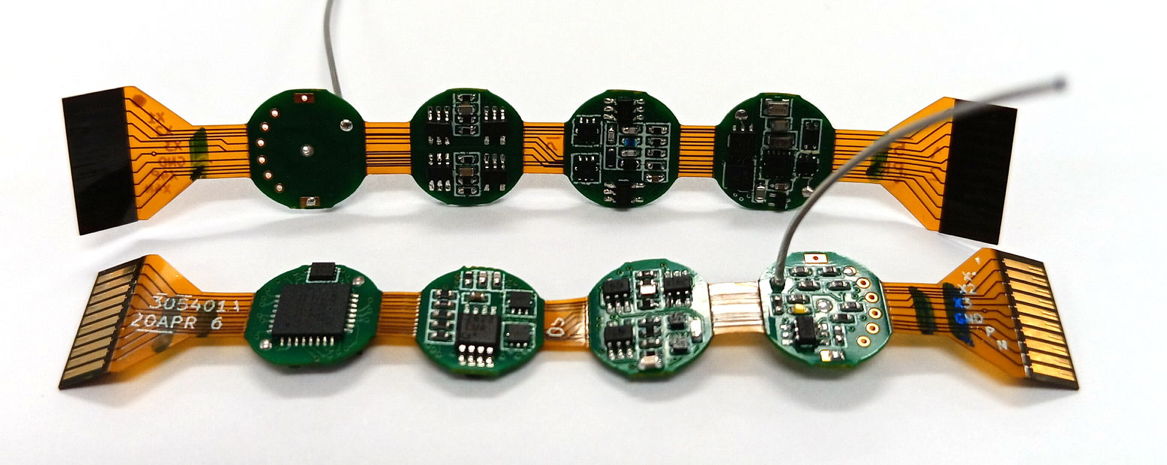
During programming in our factory, we are able to format the A3054P's non-volatile memory, set its four-digit hexadecimal identifier, calibrate its ring oscillator, calibrate its radio-frequency transmitter, and initialize its waking life clock. Once we cut the programming extensions off the circuit board, these operations can no longer be performed, not even upon an A3054P Progammable IPT. Thus it is impossible to damage the A3054P by accidentally re-calibrating it in such a way that it can no longer respond to commands or transmit acknowledgements.
At the time of writing, the A3054P Programmable IPT has proved itself in ten weeks of development and testing. We have our first two encapsulated devices, and they are performing well. We will receive twenty of A3054P circuits in September 2026. We should be able to ship the first samples to customers in October. The A3054L Long-Life IPT is currently in development. The A3054L will eliminate the crystal radio and use a less complex logic chip so as to reduce quiescent current from 40 μA to 15 μA at 37°C. Furthermore, the A3054L will introduce a new radio-fequency transmission circuit that drops the cost of sample transmission from 82 nA/SPS to 30 nA/SPS. We expect to have the first A3054L Long-Life IPTs ready for distribution in January 2027.
[04-FEB-26] For details of the design, development, and production of the A3054 Intraperitoneal Transmitter, see its Design page.


