
Open Source Instruments (OSI) specializes in electrical engineering design, manufacturing, and consulting, with a special interests in opto-electronics and wireless telemetry. We have been designing and manufacturing instruments for scientists for over twenty years. For a list of institutes, companies, and experiments we are currently collaborating with on instrument development, see our Partnerships page.
OSI was incorporated in 2004 by Kevan Hashemi (electrical engineer), James Bensinger (professor of physics), and Michael Bradshaw (electrical engineer). At that time, we were working together at the Brandeis University High Energy Physics Department (BNDHEP). We were in the middle of the construction of the End-Cap Alignment System of the ATLAS detector, one of four particle detectors being assembled for deployment on the Large Hadronic Collider (LHC) at CERN (European Center for Nuclear Research). We designed, calibrated, and manufactured thousands of cameras and light sources, shipped them all to Geneva, and installed them in the detector cavern over a period of ten years. This work was funded entirely by the US Department of Energy (DoE).

We founded OSI in order to satisfy two requests for metrology instruments from the ALICE detector at CERN. We supplied the metrology instruments and data acquisition system required by their Geometric Monitoring System (GMS) and Space Frame Monitor (SFM). These instruments were the same BCAMs we developed at BNDHEP, but now manufactured at OSI with funding from a European agency. We subsequently built BCAMs for the CMS, LHCb, and detectors as well.

Kevan Hashemi, the OSI president, has been working on alignment systems for HEP experiments since 1992, when he worked at Harvard University on the alignment of the ill-fated Superconducting Supercollider (SSC). In 1995 he started at Brandeis University and spent the next twenty-six years working on the alignment of the ATLAS detector. He now has a visiting scientist position at Tufts University, and continues to attend bi-weekly meetings of the ATLAS alignment group.

In 2006-2022, OSI designed and manufactured several generations of an optical Wire Position Sensor (WPS) for use in test stands at CERN (Geneva) and NSRL (Hefei). Metrology instrumentation for particle accelerators and detectors remains an important part of the company's business.

In 2005-2010, we designed our Subcutaneous Transmitter (SCT) in collaboration with the Institute of Neurology (ION) at University College London (UCL). The SCT is a water-proof, battery-powered, wireless sensor designed for implantation laboratory animal. The first SCTs were single-channel intracranial electroencephalogram (iEEG) transmitters for rats. We now make four-channel SCTs that record iEEG, ECG, EMG, and EGG in rats, and two-channel SCTs that record iEEG and ECG in mice.

A critical component of the SCT system is the Subcutaneous Leads (SCL). We use stretchy, flexible, silicone-insulated springs to make our SCLs, and these leads, and these have proven to be resistant to corrosion and fatigue for many months of implantation. We sell hundreds of these leads every year to other manufacturers of implantable devices.

We encapsulate our SCTs in epoxy and silicone, which makes them as small as possible. But epoxy and silicone are permeable to water vapor. If any cavities exist within the epoxy, they will fill with condensed water vapor within a few days of implantation. Corrosion caused by condensed water is the leading cause of failure of our implantable devices. Starting in 2014, we poach on in ten implantable devices in water at 60°C to measure their corrosion resistance.

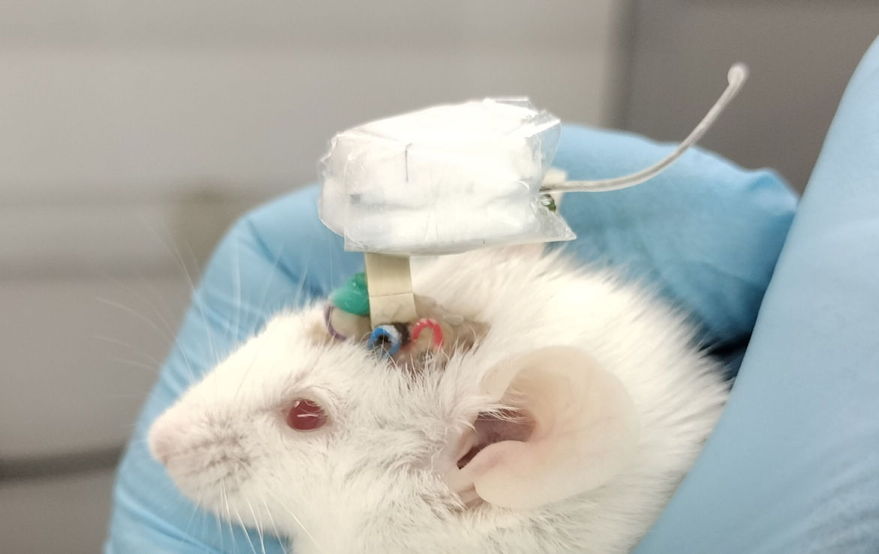
In 2022-2023 we developed our A3040 Head-Mounting transmitter (HMT) in collaboration with ION/UCL. This device attaches to a head fixture cemented to the skull of a mouse by means of a miniature electrical connector. Animals equipped with HMTs cannot be co-housed, but we can record from them indefinitely by swapping the HMT on their head once a week, and replacing the battery in the exhausted HMT. Each time we swap HMTs, we do so with a pair of identical devices that transmit on the same channel numbers. So long as the cemented head fixture remains intact, the recording can continue. Even if the mouse removes the HMT and chews on it, we can deploy a fresh HMT to continue the experiment.
We began work on an implantable optical stimulator in 2012, in collaboration with ION/UCL with funding provided by the Wellcomme Trust. We record our development of a micropower radio receiver and an efficient fiber-coupled light-emitting diode in our ISL Development blog. In 2020, we received funding from the National Institute of Health (NIH) to continue development of our implantable stimulators in collaboration with Cornell University. We demonstrated the efficacy of the Implantable Stimulator-Transponder (IST) and Fiber-Coupled LED (FCLED) for optogenetic experiments in 2021 in collaboration with ION/UCL.

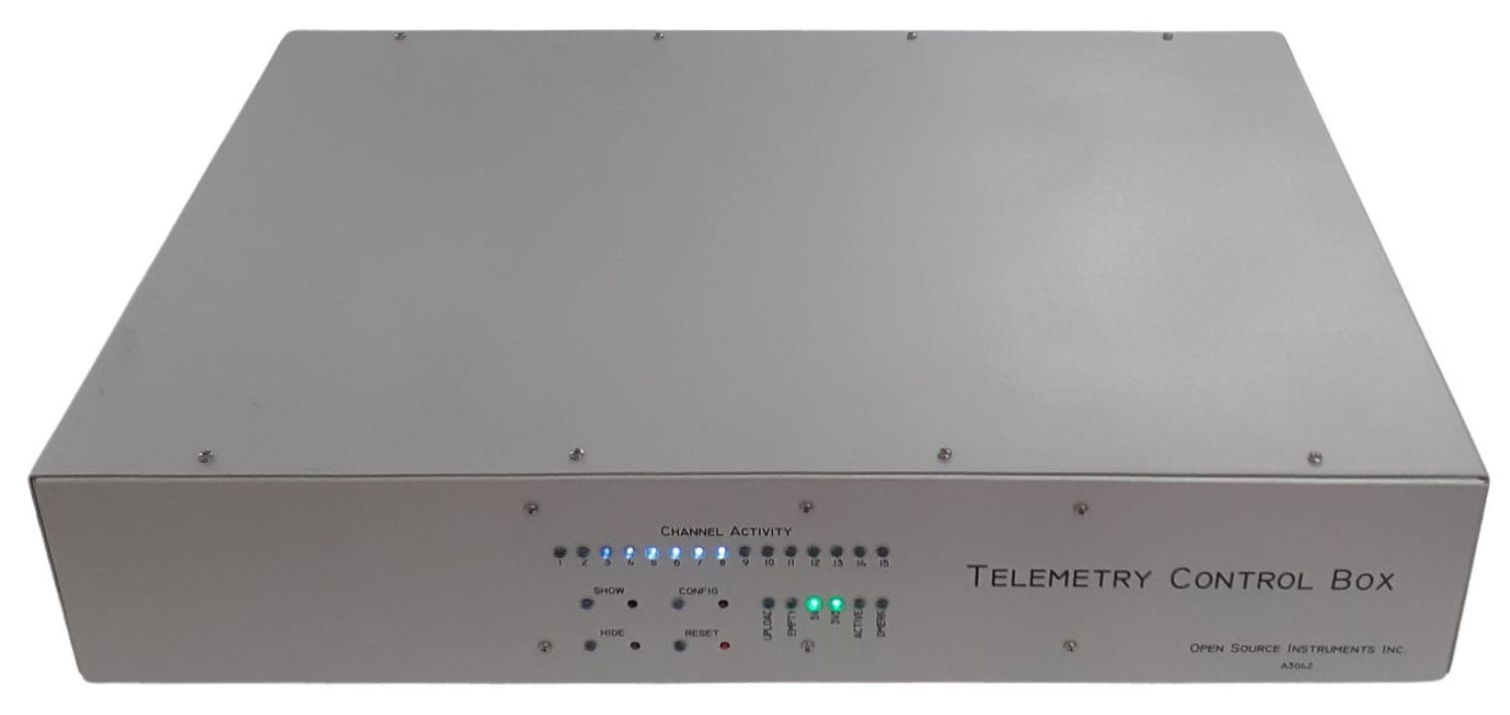
In 2024, we released our A3042B-16 Telemetry Control Box (TCB). This instrument provides sixteen independent, telemetry receivers and sixteen independent command transmitters. The receivers and transmitters share the same antennas, so that we have an all-in-one telemetry controller. In 2026, we released the smaller A3042B-4 TCB, a four-way telemetry control box that also provides both telemetry reception and command transmission.
We are currently working on the development and testing of a number of new implantable devices. We are collaborating with Duzce University in Turkey and Avastus Preclinical Services in America to perfect the surgical protocol for our A3051 Blood Pressure Monitor (BPM). We expect the rat and mouse-sized versions of the A3051 to go into production in January 2027. The A3054P Programmable Intraperitoneal Transmitter (IPT) is an implant with four biopotential amplifiers, an accelerometer, a thermometer, and an on-board microprocessor that allows us to re-configure the IPT with any combination of measurements even while it is implanted in an animal. The A3054P will be available for purchase in November 2026. The A3054L Long-Life IPT is a factory-configured version of the A3054P that will trade programmability for extended operating life. The A3054L will be the first of our implantable devices to deploy our new, high-efficiency radio-frequency oscillator. In 2027 we will release a new generation of telemetry sensors equipped with this new oscillator as well as several other advances we have made in the past few years. The higher efficiency of the new devices will allow us to reduce their mass while at the same time extending their operating life and operating range.
We like to attend conferences on epilepsy and sleep so that we can talk face-to-face with our existing customers, and also make ourselves available to talk to potential new customers.

Whenever possible, when we exhibit at a conference, we set up our telemetry system in our booth and demonstrate telemetry reception and command transmission to our visitors.

Conferences also allow us to attend poster sessions in which we get so see what our academic and pharmaceutical customers are doing with our telemetry system.

We exhibited at the International Conference on Cortical Spreading Depolarization (iCSD) in Turkey in November 2024, the American Epilepsy Society (AES) meeting in Los Angeles in December 2024, and the Sleep 2025 meeting in Seattle, 8-11 June 2025. On 10 July, at 11 am in the morning London time, we hosted a seminar at the Institute of Neurology, University College London. The topic was "OSI Telemetry: Use and History".

On September 25th, 2025, we hosted an event with MassBio to discuss small-animal telemetry with potential new customers in the Boston area. It was pouring with rain that day, with flooding on the highways. Only one person made it to the event, and he was one of our board members. Nevertheless, we set up a complete canopy telemetry system in downtown Boston in half an hour and obtained perfect telemetry reception and stimulator control immediately.

In December 2025 we exhibited the American Epilepsy Society meeting in Atlanta. We attended the SLEEP 2026 conference in Baltimore, USA from June 14th to 16th, where we discussed sleep scoring with experts and met with potential users of our telemetry system for sleep studies. We exhibited at the European Epilepsy Congress in Athens, Greece, from September 6th to 8th.
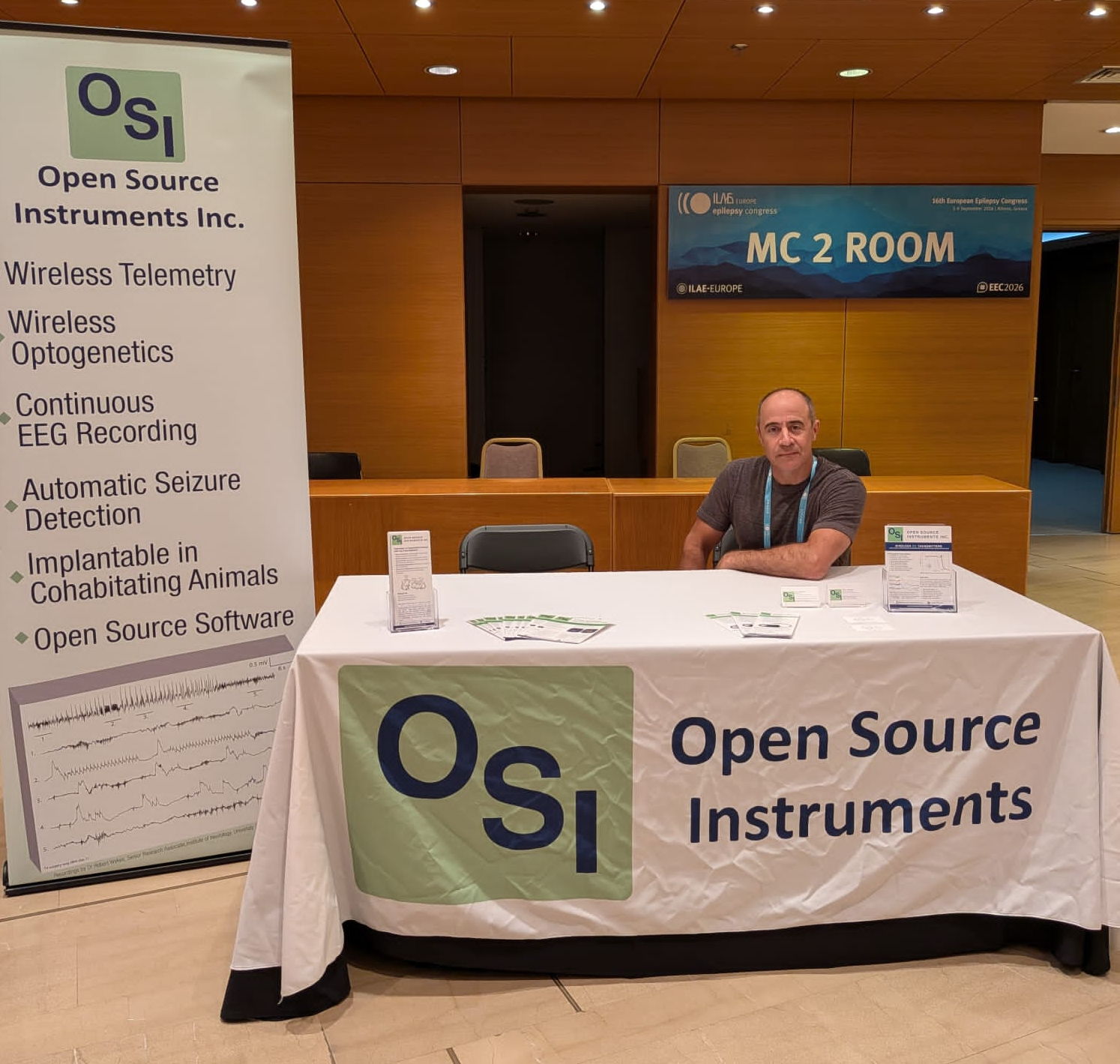
We will be at the American Epilepsy Society meeting in Denver, USA from December 4th to 8th. There we will demonstrate our new A3042B-4 Four-Way Telemetry Control Box, our A3054P Programmable Intraperitoneal Transmitter, our mouse-sized A3051 Blood Pressure Monitor, and our high-power A3041 Implantable Stimulator-Transponder for optogenetic experiments.