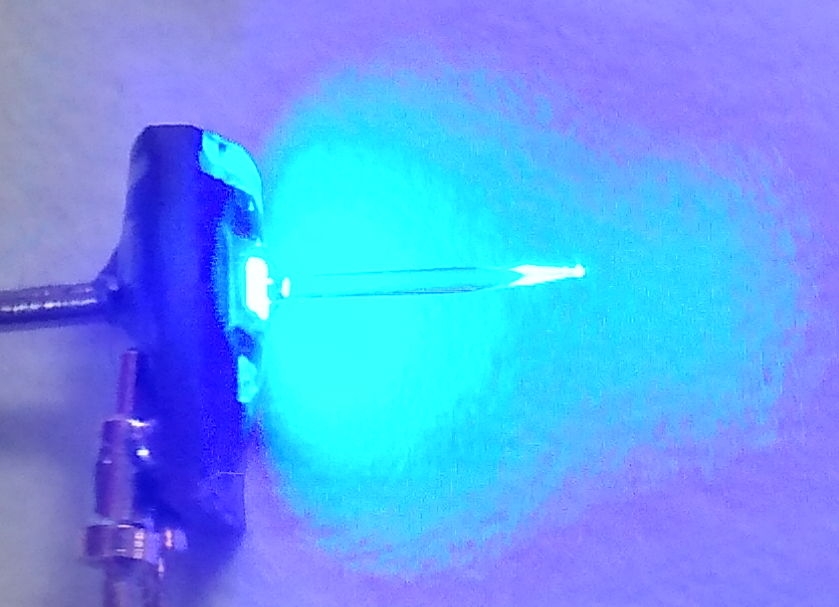
Our Implantable Light-Emitting Diodes (ILEDs) operate with our implantable transponders to provide optical stimulation for optogenetic experiments in mice and rats. Our Clear-Epoxy LEDs (CE-LEDs) fasten to the surface of an organ, the surface of the skull, or shine through a hole made in the skull. They come in red, green, and blue. Our Blunt-Fiber LEDs (BF-LEDs) are designed to be anchored to the skull and deliver light to the surface of the brain just beneath the skull, without penetrating the dura. Our Tapered-Fiber LEDs (TF-LEDs) are designed to be anchored to the skull and provide illumination deeper in the brain. The tapered fiber penetrates the brain to deliver light below the surface. Our BF-LEDs and TF-LEDs come in green and blue, but not red. All ILEDs are equipped with sockets that accept the pins on the end of the stimulation leads, as well as a post by which the ILED can be held during surgery. The post is thinned just above the ILED so we can cut the ILED free after we have cemented the ILED in place.
Our CE-LEDs we make by encapsulating an efficient blue, green, or red LED in clear epoxy. The blue and green LEDs require a forward voltage of about 3.0 V to drive with 10 mA. The red LED needs only 2.2 V for the same current. Our The TF-LED and BF-LED are a light-emitting diode with a fiber-optic light guide glued to its surface. We have not yet found a bare-die red LED efficient enough and small enough to make a practical fiber-coupled ILED. All our fiber-coupled ILEDs are blue or green and require 3.0 V to drive. Our TF-LEDs can have fibers of diameter 270-450 μm and length 3-10 mm.